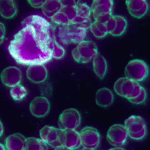
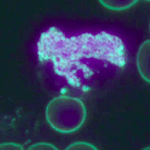
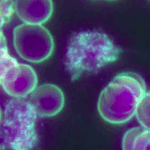
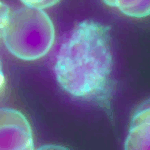
At the centre of the field, we see a large, glowing white blood cell surrounded by red cells. Unlike the smooth discs of the red cells, this one is grainy and alive with motion. Across these stills, the immune cell is extending delicate arm-like projections called pseudopods. These reach outward into the plasma, brushing against nearby red cells as they drift past — as though the immune cell is scanning its environment for signs of danger.
Immune Cell Fact:
Phagocytic white blood cells like this use pseudopods to sense, attach, and engulf foreign particles. If they encounter something that doesn’t belong, they can surround it and draw it inside. Once engulfed, the cell unleashes an oxidative burst — a chemical storm that breaks the invader apart into smaller molecules. Far from waste, those fragments (amino acids, sugars, lipids) can be recycled as raw materials to build and repair healthy tissue.
Condition of the Red Cells:
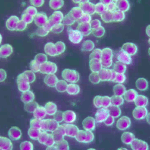
The red blood cells here are round and intact, showing healthy membranes with bright halos. A few are slightly overlapping, but most remain separate — no heavy clumping or deformation is visible.
Other Observation:
Notice how the immune cell stands out from the calm sea of red cells. The red cells move passively with the plasma currents, but this white cell actively reshapes itself, reaching and retracting — a true display of your immune system’s living intelligence.
 Disclaimer