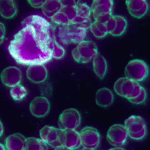
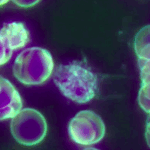
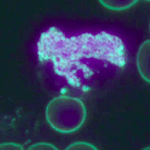
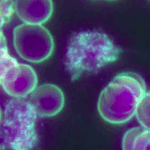
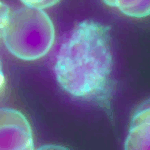
Here we see a wide field of red blood cells drifting across the plasma. As the sample settles on the slide, the motion of the plasma creates a gentle flow, showing us how the blood would move through vessels inside the body. Among the sea of red cells, several larger white blood cells can be seen. Unlike the red cells that glide past, these immune cells remain fixed in place, “sticking” to the slide surface, which makes them stand out clearly.
Immune Cell Fact:
White blood cells are naturally more adhesive than red cells. In the body, this stickiness allows them to anchor to vessel walls, preparing to exit the bloodstream when they need to fight infection or repair tissue. What we see here on the slide mirrors that same behaviour: while red cells flow like cargo ships, the immune cells act as sentinels, holding position and watching for danger.
Condition of the Red Cells:
The red blood cells are round and intact, glowing with bright halos that indicate healthy membranes. Many are sliding into light stacks or rouleaux formations — a normal effect when plasma proteins increase stickiness as the sample rests.
Other Observation:
This wide view is a reminder that blood is not static. It is a living river of movement, carrying oxygen, nutrients, and signals. The rare white cells, scattered among the countless red ones, show just how precious and specialised our immune defenders are.
 Disclaimer