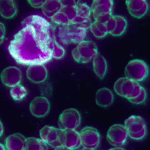
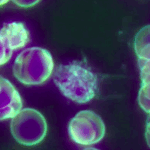
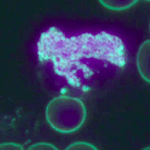
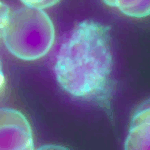
In this sequence, we see not one but two immune cells in the plasma, positioned between clusters of red blood cells. Both are alive with motion, extending and retracting pseudopods in many directions. As they reach outward and then draw back, it looks like a carefully timed dance — a biological ballet unfolding right before our eyes.
Immune Cell Fact:
Phagocytic immune cells like these constantly test their surroundings with pseudopods. This probing movement is how they sense, attach to, and eventually engulf foreign material. What looks like an elegant performance is in fact a highly coordinated survival strategy: each extension is a question — “friend or foe?” — and each retraction a decision made in milliseconds.
Condition of the Red Cells:
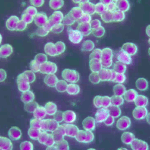
The surrounding red blood cells appear healthy and intact, glowing with bright outlines. Some are gathered in light clusters, sliding over each other, but most remain round and uniform. Their calm, steady presence forms a still backdrop to the immune cells’ restless activity.
Other Observation:
Seen together, these two white blood cells almost mirror each other’s movements. It’s a reminder that the immune system isn’t random — it is orchestrated, with cells responding to shared signals, moving in harmony to keep the body safe.
 Disclaimer