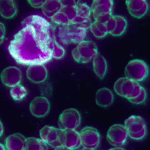
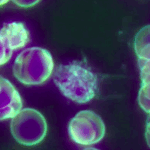
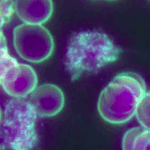
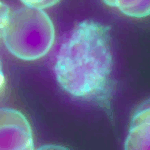
At the centre of the field, we see a striking granular white blood cell, glowing with bright, sparkling inclusions. These granules stand out in sharp contrast to the smooth red blood cells drifting calmly around it. Across the stills, the cell shifts shape, and one especially bright granule seems to move toward the cell’s edge — as though it’s preparing to be released into the plasma.
Immune Cell Fact:
This is likely a basophil, one of the rarest but most powerful immune cells. Instead of swallowing pathogens like neutrophils do, basophils act as signal carriers. Their granules are packed with histamine and other chemical messengers. When released, these molecules open blood vessels and summon reinforcements, helping other immune cells arrive quickly at the scene. The drifting granule you see here could be part of that process — a messenger packet on its way to the cell’s surface.
Condition of the Red Cells:
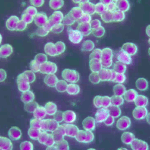
The surrounding red blood cells look round and intact, glowing with bright halos that signal healthy membranes. Some are overlapping lightly, but they remain separate and distinct — no major clumping is visible.
Other Observation:
Notice the contrast: while the red blood cells simply carry oxygen, this basophil is alive with chemical energy, preparing to broadcast signals that can reshape the immune response in an instant. It’s a reminder that not all immune battles are fought with force — some are fought with messages.
 Disclaimer