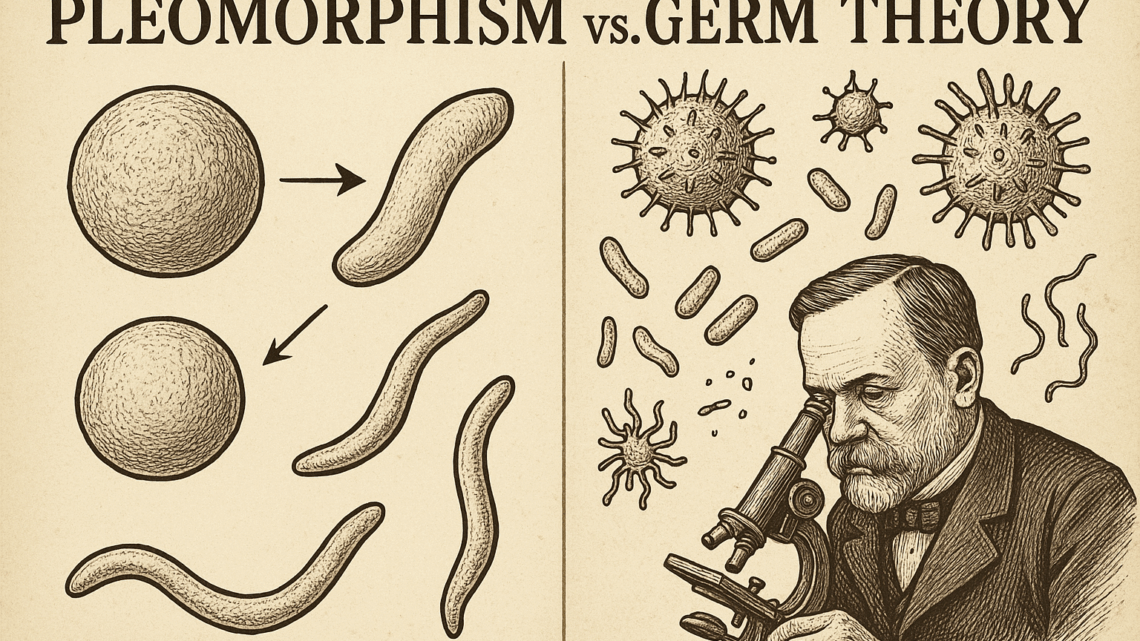
In the history of medicine and microbiology, two competing theories have shaped our understanding of how diseases arise and spread: the germ theory and pleomorphism (often linked to terrain theory). These ideas, originating in the 19th century, represent fundamentally different views on the role of microorganisms in illness. While germ theory has become the cornerstone of modern medicine, pleomorphism persists in alternative health circles as a counterpoint emphasising the body’s internal environment. This article delves into both theories, their historical context, key differences, and how darkfield microscopy plays a part—primarily in supporting observations tied to pleomorphism.
The Germ Theory: Microbes as the Primary Culprits
The germ theory of disease posits that specific microorganisms, such as bacteria, viruses, fungi, and parasites, are the direct causes of specific infectious diseases. This theory suggests that these “germs” invade the body from the external environment, multiply, and lead to illness. Once inside a host, they can be transmitted to others through various means, such as air, water, or direct contact.
The foundations of germ theory were laid by scientists like Louis Pasteur and Robert Koch in the late 1800s. Pasteur’s experiments with fermentation and pasteurisation demonstrated that microbes could spoil food and cause disease, while Koch’s postulates provided a framework for proving that a particular microbe causes a specific disease: isolate the microbe from a diseased host, grow it in culture, infect a healthy host with it, and re-isolate the same microbe from the newly diseased host. This approach revolutionised medicine, leading to advancements in hygiene, vaccination, antibiotics, and public health measures that dramatically reduced mortality from infectious diseases like cholera, tuberculosis, and smallpox.
Critics of germ theory, however, argue that it oversimplifies disease by ignoring the host’s internal conditions. They point out that not everyone exposed to the same pathogen gets sick, suggesting factors like immunity, nutrition, and overall health play a role. Nonetheless, germ theory remains the dominant paradigm in mainstream science, supported by overwhelming empirical evidence from microbiology and epidemiology.
Pleomorphism: The Terrain Matters More Than the Germ
In contrast, pleomorphism, championed by Antoine Béchamp and later figures like Günther Enderlein, proposes that microorganisms are not fixed invaders but can change form (pleomorph) depending on the body’s internal “terrain” or environment. According to this view, disease arises not primarily from external germs but from imbalances in the body’s pH, toxicity levels, nutrition, and overall vitality. Microbes, in this theory, are seen as symbionts—beneficial or neutral entities that can morph into pathogenic forms only when the terrain is disrupted.
Béchamp, a contemporary and rival of Pasteur, argued that tiny particles he called “microzymas” (later echoed in concepts like symbionts or protits) are present in all living things and can evolve into bacteria, yeasts, or other forms based on environmental cues. For instance, a healthy alkaline terrain might keep these entities benign, while an acidic, toxic one could trigger their transformation into disease-causing agents. Proponents of pleomorphism often tie it to terrain theory, which emphasises holistic health practices like diet, detoxification, and lifestyle to maintain internal balance and prevent illness.
This theory gained traction in the early 20th century through researchers like Enderlein, who developed isopathic remedies based on pleomorphic observations. However, it has been largely dismissed by conventional science as pseudoscientific, with critics labelling it a form of germ theory denialism. They argue that pleomorphism lacks rigorous evidence and that observed microbial changes are often artefacts of poor experimental conditions or misinterpretations. Despite this, it influences alternative therapies today, including naturopathy and some nutritional approaches.
Key Differences and the Ongoing Debate
The core divide between germ theory and pleomorphism lies in causation: germ theory focuses on external pathogens as the primary agents, advocating for interventions like antibiotics to target them directly. Pleomorphism, conversely, shifts blame to the host’s terrain, promoting preventive measures to strengthen the body’s resilience rather than attacking microbes. Historical anecdotes, such as Pasteur’s alleged deathbed recantation (“The microbe is nothing; the terrain is everything”), fuel the debate, though this quote is apocryphal and likely misattributed.
In modern terms, elements of both theories coexist in concepts like the microbiome and epigenetics, where environmental factors influence gene expression and microbial behaviour. Some hybrid models, such as germ-terrain duality, suggest that while germs can initiate disease, the terrain determines susceptibility and severity. Yet, mainstream medicine prioritises germ theory for its testable predictions and life-saving applications, while pleomorphism is often critiqued for lacking falsifiability and promoting unproven treatments.
Darkfield Microscopy: A Tool Tied to Pleomorphism
Darkfield microscopy is an optical technique that illuminates samples from the side, creating high-contrast images where unstained, live specimens appear bright against a dark background. Unlike brightfield microscopy, which requires staining (often killing the sample), darkfield allows real-time observation of living tissues, making it ideal for studying dynamic processes.
This method fits primarily into pleomorphism rather than germ theory. Proponents use darkfield in live blood analysis to observe supposed pleomorphic changes in blood cells and microorganisms, such as microzymas evolving into bacteria or other forms. Figures like Enderlein relied on darkfield to document these transformations, claiming it reveals symbionts that shift based on terrain conditions—observations invisible under standard microscopes. In alternative health, darkfield is employed to assess blood quality, detect imbalances like acidity or toxicity, and guide nutritional interventions.
However, darkfield has limited relevance to germ theory, which favours cultured, stained samples for precise identification of fixed pathogens via methods like Koch’s postulates. Critics argue that darkfield artefacts—such as debris or non-living particles mistaken for pleomorphic microbes—undermine its reliability in pleomorphic claims. Scientific reviews often classify live blood analysis via darkfield as unproven or quackery, with no diagnostic value beyond basic haematology. Still, it remains a popular tool in holistic practices for visualising the “terrain” in action.
Conclusion
The debate between pleomorphism and germ theory highlights a tension between holistic, internal-focused approaches and targeted, external-pathogen models in understanding disease. While germ theory underpins much of contemporary healthcare, pleomorphism offers a reminder of the importance of lifestyle and environment. Darkfield microscopy, as an observational bridge, amplifies pleomorphic ideas but faces scepticism from evidence-based science. Ultimately, integrating insights from both could enrich our approach to health, though rigorous research is essential to bridge the gap.
 Disclaimer