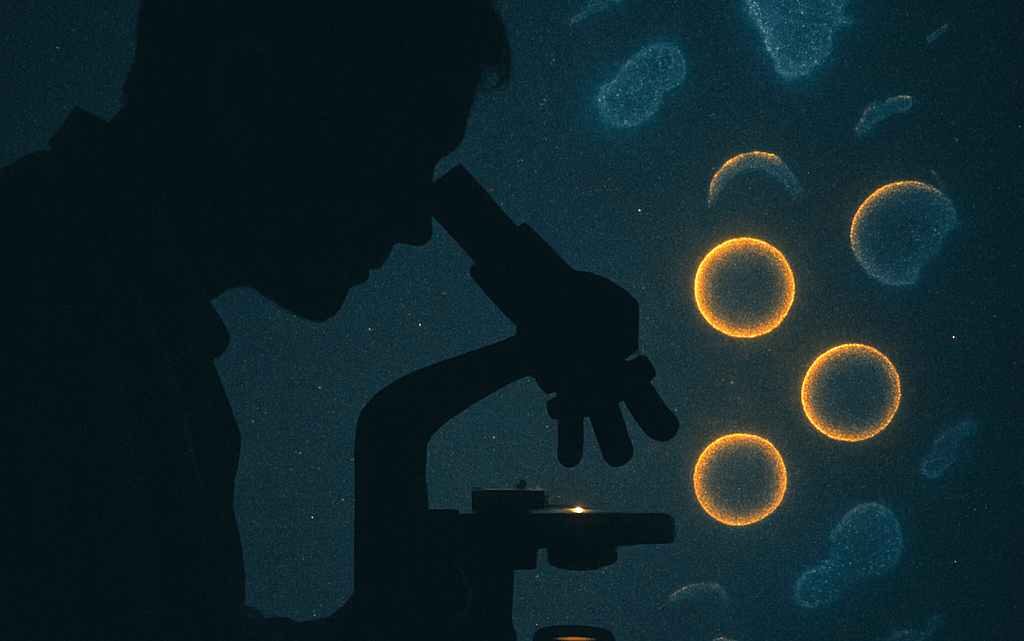
Dark-field microscopy is a specialised optical technique that transforms how we observe biological samples, particularly blood, by creating striking contrast without the need for staining. Unlike traditional bright-field microscopy, which illuminates samples directly, dark-field microscopy highlights fine details and dynamic processes in live specimens, making it a valuable tool in both research and alternative diagnostic practices. This article explores the principles, applications, advantages, and limitations of dark-field microscopy in blood analysis, as well as its role in modern haematology.
Principles of Dark-Field Microscopy
Dark-field microscopy operates by manipulating light to enhance contrast. A specialised condenser with an opaque central disk blocks direct light from entering the objective lens, allowing only oblique, scattered light to illuminate the specimen. This results in a bright, glowing sample against a dark background, as only the light scattered by the specimen’s structures reaches the viewer or camera. The technique emphasises edges, surfaces, and small particles that might otherwise be invisible due to low contrast in standard microscopy.
In blood analysis, this setup is particularly effective for observing live, unstained samples. The high contrast highlights cellular boundaries, motility, and subtle features without the need for dyes that could alter or kill the cells. The result is a vivid, real-time view of blood components in their natural state.
Applications in Blood Analysis
Dark-field microscopy is especially suited for examining fresh, unstained blood samples, offering insights into cellular dynamics and subtle abnormalities. Key applications include:
Live Blood Analysis: Practitioners use dark-field to observe the shape, size, and motility of red blood cells (erythrocytes), white blood cells (leukocytes), and platelets. It can reveal red cell flexibility, aggregation, or irregularities like rouleaux (stacked red cells), which may suggest oxidative stress or poor circulation.
Detection of Microorganisms: The technique’s sensitivity to small, light-scattering particles makes it useful for identifying bacteria, spirochetes, or other microbes in blood, which might be missed in bright-field without staining.
Nutritional and Functional Assessments: In alternative medicine, dark-field is used to assess blood health, such as signs of nutritional deficiencies or environmental toxin effects, though these applications are debated in mainstream medicine due to subjective interpretation.
Research Applications: Scientists employ dark-field to study cellular interactions, membrane dynamics, or the effects of stressors on blood cells in real time, providing data that stained, fixed samples cannot.
For example, dark-field can reveal the undulating motion of white blood cells or detect spicules (protrusions) on red cells, which may indicate membrane damage. These observations are critical for understanding blood behaviour under physiological conditions.
Advantages of Dark-Field Microscopy
Dark-field microscopy offers several benefits, particularly for blood analysis:
High Contrast for Unstained Samples: It excels at visualising transparent or low-contrast specimens, making it ideal for live blood without the need for staining, which preserves cell viability.
Dynamic Observations: The ability to observe live cells in motion provides insights into functional properties, such as cell motility or interactions, that are lost in fixed preparations.
Sensitivity to Small Structures: Dark-field highlights tiny particles or organisms, such as bacteria or cellular debris, that might be overlooked in other methods.
Non-Destructive: Since staining is unnecessary, cells remain intact, allowing for repeated observations or additional testing.
These advantages make dark-field a powerful tool for researchers and practitioners interested in real-time blood analysis.
Limitations and Challenges
Despite its strengths, dark-field microscopy has notable limitations:
Artifact Sensitivity: Dust, air bubbles, or debris in the sample can scatter light and appear as false positives, requiring careful preparation and interpretation.
Limited Internal Detail: While edges and surfaces are highlighted, internal cellular structures may be less visible compared to stained bright-field images.
Not Ideal for Thick Samples: Dense or thick specimens can scatter too much light, reducing clarity and making it unsuitable for certain preparations.
Controversy in Clinical Use: In alternative medicine, dark-field live blood analysis is popular but criticised for lacking standardised protocols and scientific validation, leading to scepticism in conventional medical settings. Proper training and meticulous sample handling are essential to mitigate these issues and ensure reliable results.
Dark-Field Microscopy in Modern Blood Analysis
While dark-field microscopy is a niche technique compared to automated haematology analysers, it remains relevant in specific contexts. Modern blood analysis primarily relies on high-throughput technologies like flow cytometry, electrical impedance, and optical scatter for complete blood counts (CBCs) and biochemical assays. These systems process thousands of cells per second, providing quantitative data on cell counts, haemoglobin, and more. However, dark-field microscopy complements these methods by offering qualitative insights into live cell behaviour.
In research, dark-field is used to study blood cell dynamics or pathogen interactions, often in conjunction with advanced imaging like fluorescence or phase-contrast microscopy. In alternative medicine, practitioners use it for live blood analysis, though its diagnostic claims are debated. Emerging technologies, such as AI-assisted image analysis, are beginning to enhance dark-field microscopy by improving artefact detection and standardising interpretations.
Conclusion
Dark-field microscopy is a unique and powerful tool for visualising live blood samples, offering unparalleled contrast and the ability to observe cellular dynamics in real time. Its applications range from research to alternative medicine, though its clinical use requires careful interpretation to avoid overdiagnosis. As modern blood analysis leans heavily on automation, dark-field remains a valuable complement, providing detailed, qualitative insights into the living blood environment. With advancements in imaging and standardisation, its role in both science and diagnostics may continue to evolve.
 Disclaimer