You must be logged in to record observations.
Short Description
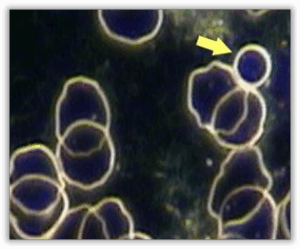
- Spherocytes are red blood cells that appear more rounded and compact than typical red blood cells, lacking the usual central lighter area seen in healthy cells. Instead of a flexible, biconcave shape, these cells appear dense and uniformly coloured.
- This change in shape reflects a reduction in red blood cell surface flexibility. Because red blood cells normally rely on their ability to deform as they move through small blood vessels, a more spherical form can influence how efficiently they circulate.
- In live blood analysis, it is common to observe an occasional spherocyte within a sample. However, when a noticeable number of red blood cells display this rounded appearance across multiple fields of view, it suggests a broader pattern rather than an isolated variation, indicating altered red blood cell membrane behaviour within the circulating environment.
Appearance
Spherocytes are small, spherical RBCs, approximately two-thirds the diameter of normal RBCs and lack a zone of central pallor. They appear significantly darker and smaller than normal RBCs in brightfield and have a thicker and brighter cell membrane in darkfield.
Pleomorphic Perspective
These forms develop as a result of consumption of the erythrocyte’s material by the endobiont. Careful inspection of the sample will reveal that there are advanced phases of the endobiont occurring.
Medical Perspective
The spherocyte is an erythrocyte in which the biconcave disc profile is lost. It is formed when there is a defect in the membrane function. The sodium pump causes Na+ retention which increases water retention, increasing the intracellular volume. This cell is the predominant morphologic abnormality in patients with hereditary spherocytosis, autoimmune haemolytic anaemia and haemolytic transfusion reactions. It can also be observed in haemolytic states such as the Heinz body haemolytic anaemias, clostridial sepsis, hypophosphataemia (low serum phosphate concentration), toxins and traumatic injury.
Relevance
- Spherocytes are not usually observed in normal live blood samples. This finding is significant when seen during analysis.
Implications
- Spherocytes are a fairly rare finding in live blood analysis. Spherocytosis occurs in immune-mediated haemolytic anaemia or from hereditary factors.
- In blood analysis, finding a few spherocytes in a sample is regarded as a sign of inflammation.
Associated Symptoms
- Pain at the focus of inflammation.
- Jaundice and signs of haemolytic anaemia.
- May be asymptomatic.
Interventions
Any combination of the following, depending on the rest of the case:
INFLAMMATION PROTOCOL:
- HumiCaps 2–4 capsules 2–4× daily.
- Curcumigen: 1 capsule 1–2× daily.
- Glutathione: 1 capsule 1–2× daily.
- Trace minerals: Bio-Ionic Minerals.
- Omega-3 supplement (1000–2000 mg EPA daily).
Working with
Spherocytes may be related to severe inflammation or immune-mediated haemolytic anaemia. Correlate clinically to determine the most likely cause. The interventions outlined above are geared towards addressing inflammation. Natural interventions to address immune-mediated haemolytic anaemia also utilize natural anti-inflammatories, in addition to Bio-Algae Concentrates (BAC), containing a mixture of Spirulina pacifica, Spirulina platensis, Dunaliella salina and astaxanthin from Haematococcus pluvialis. It is clear that the powerful antioxidant and anti-inflammatory effect of astaxanthin will have a beneficial effect in this condition.
General Guidelines
- Increase water intake. To determine necessary daily water intake (in litres): Weight (kg)/8) x 0.25.
- Reduce animal protein and acid-forming foods.
- Increase intake of fibre-rich carbohydrates (those tolerated by the blood type) and raw, polyunsaturated fats.
- Avoid saturated fat, refined carbohydrates and food deficient in natural enzymes.
- Avoid alcohol, caffeine, sugar, drugs and non-essential medication.
- Raw vegetable juices, sprouts, greens and superfoods.
Functional Systems Influenced
Hematological
Spherocytes reflect a change in red blood cell shape and membrane behaviour, directly influencing how red blood cells function within the bloodstream. The more compact form can reduce flexibility, which is important for normal circulation.
Circulation & Hydration
Red blood cells rely on adequate flexibility to move efficiently through small blood vessels. When cells become more spherical, their ability to deform may be reduced, which can influence circulation quality, particularly at the microcirculatory level.
Oxidative & Antioxidant Balance
Red blood cell membranes are sensitive to oxidative influences. Reduced oxidative balance may affect membrane integrity, contributing to changes in cell shape and resilience over time.
Commonly Associated Terrain Imbalances
Acidic terrain
Shifts toward a more acidic internal environment can influence red blood cell membrane stability, encouraging loss of flexibility and a more compact, rounded cell shape.
Dehydration / plasma viscosity
Reduced plasma fluidity can increase mechanical stress on red blood cells, contributing to reduced membrane adaptability and a tendency toward spherical forms.
Low antioxidant reserve
When antioxidant protection is limited, red blood cell membranes may be less resilient to everyday environmental stressors, allowing shape changes to persist.
Oxidative stress
Oxidative influences can affect membrane proteins and lipids, reducing flexibility and contributing to a loss of the normal biconcave shape.
Protein intake / albumin low
Adequate plasma protein balance supports red blood cell membrane integrity. Reduced albumin availability may influence membrane behaviour and cell shape stability.
Systems / Body Functions
Circulation & Hydration, Hematological, Oxidative & Antioxidant Balance
Imbalances
Acidic terrain, Dehydration / plasma viscosity ↑, Low antioxidant reserve, Oxidative stress ↑, Protein intake/albumin low
- Spherocytes are red blood cells that appear more rounded and compact than typical red blood cells, lacking the usual central lighter area seen in healthy cells. Instead of a flexible, biconcave shape, these cells appear dense and uniformly coloured.
- This change in shape reflects a reduction in red blood cell surface flexibility. Because red blood cells normally rely on their ability to deform as they move through small blood vessels, a more spherical form can influence how efficiently they circulate.
- In live blood analysis, it is common to observe an occasional spherocyte within a sample. However, when a noticeable number of red blood cells display this rounded appearance across multiple fields of view, it suggests a broader pattern rather than an isolated variation, indicating altered red blood cell membrane behaviour within the circulating environment.
These forms develop as a result of consumption of the erythrocyte’s material by the endobiont. Careful inspection of the sample will reveal that there are advanced phases of the endobiont occurring.
 Disclaimer