You must be logged in to record observations.
Short Description
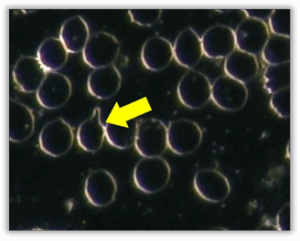
- Single membrane protrusion describes a red blood cell that displays one distinct outward bulge or projection from an otherwise smooth, rounded membrane. Unlike cells with multiple spikes or widespread shape distortion, the remainder of the cell typically retains its normal appearance.
- In live blood analysis, this pattern may be seen affecting individual red blood cells rather than appearing uniformly across the sample. The protrusion reflects a localized change in membrane behaviour, suggesting a temporary imbalance or focal stress acting on the cell surface rather than a permanent structural alteration.
- The presence of single membrane protrusions highlights a blood environment where red blood cell membranes may be responding dynamically to surrounding conditions, with shape changes that are often subtle and potentially reversible.
Appearance
- RBC with one blunt, finger-like projection. These cells may resemble tennis rackets and should be differentiated from elliptocytes and acanthocytes. Elliptocytes are oval-shaped RBCs, while acanthocytes have 3–10 membrane protrusions.
Pleomorphic Perspective
- These forms develop as a result of the bacterial phase of the endobiont’s life cycle. Bacterial rods can be seen emerging from RBCs. These are ascits of Leptotrichia buccalis, the bacterial phase of Mucor racemosus Fresen. They are associated with lowered or deficient resistance.
Medical Perspective
- These forms are regarded as Dacrocytes (tear-drop cells or tennis racket cells). They are most often observed in pernicious anaemia and thalassaemia. They can also occur in patients with myeloid dysplasia, severe haemolytic anaemia, extramedullary haematopoiesis, myelophthisic anaemia and erythroleukaemia.
Relevance
- These forms are not observed in normal blood samples and are significant when observed during analysis.
Implications
- Most researchers consider single membrane protrusions to be an earlier form of an acanthocyte and indicative of the same imbalances as acanthocytes, as the mechanism is the same.
- Possible liver and spleen dysfunction.
- This abnormality of the RBC membrane is caused by a change in the lipid distribution in the RBC membrane, resulting in an altered membrane lipid composition. These cells have excess cholesterol in the cell membrane, which expands the outer leaflet of the lipid bilayer, resulting in blunt, irregular projections.
- Essential Fatty Acid deficiency; Vitamin E deficiency
- Poor digestion of dietary fats.
- Observed in clients after removal of the gall bladder.
- Gall bladder dysfunction, possible gall stones.
Associated Symptoms
- Nausea or digestive discomfort after consuming fatty foods.
- Fatigue
- Drowsiness
- Poor circulation.
- Possible signs of liver disease.
- Asymptomatic in many cases.
Interventions
Liver Protocol:
- Avoid alcohol, caffeine, tobacco, saturated/animal fat, sugar, drugs and non-essential medication.
- Hepaton: 30 drops tincture 3× daily. May be increased to 5ml tincture 3× daily.
Supplements:
- Omega-3 supplement (1000–2000 EPA daily).
- Vitamin E: start with 400 mg daily and gradually increase to 800 mg – Buffered vitamin C (2500 mg).
General Guidelines
- Restrict intake of dietary saturated fats.
- Increase water intake: Weight (kg) ÷ 8 × 0.25 = litres/day.
- Increase intake of fibre-rich carbohydrates and raw, polyunsaturated fats.
- Avoid saturated fat, refined carbohydrates and enzyme-deficient foods.
- Avoid alcohol, caffeine, sugar, drugs and non-essential medication.
- Include raw vegetable juices, sprouts, greens and superfoods.
- Increase essential minerals and electrolyte intake
Functional Systems Influenced
Hematological
A single membrane protrusion reflects a localized change in red blood cell membrane behaviour. This highlights how individual cells may respond to focal stress or imbalance within the circulating blood environment.
Circulation & Hydration
Red blood cell membranes are sensitive to fluid balance and shear forces within circulation. Subtle changes in hydration or plasma conditions can influence membrane tension, leading to localized protrusions.
Oxidative & Antioxidant Balance
Oxidative influences can affect membrane stability at specific points on the red blood cell surface. Reduced antioxidant protection may contribute to focal membrane responses rather than widespread shape change.
Commonly Associated Terrain Imbalances
Acidic terrain
A more acidic internal environment can influence red blood cell membrane charge and tension, increasing the likelihood of focal membrane distortion rather than uniform shape change.
Dehydration / plasma viscosity
Reduced plasma fluidity can alter membrane pressure dynamics, making localised protrusions more likely as cells respond to subtle mechanical stress.
Low antioxidant reserve
Limited antioxidant protection may reduce membrane resilience at specific points, allowing small, localised changes to appear without affecting the entire cell.
Oxidative stress
Oxidative influences can weaken membrane structure unevenly, contributing to isolated protrusions rather than widespread membrane alteration.
Supportive Focus & Awareness
-
Awareness of factors that influence red blood cell membrane tension and stability
-
Awareness of hydration and fluid balance as they relate to subtle changes in cell shape
-
Awareness of oxidative balance and everyday influences on membrane resilience
-
Awareness of circulation quality and how gentle mechanical forces may affect individual cells
-
Awareness of overall energy levels and recovery during periods of physical or metabolic demand
Commonly Reported Experiences
- In many cases, individuals whose blood patterns include single membrane protrusions do not report any specific or noticeable symptoms and may feel generally well.
- Where experiences are reported, they are often subtle and non-specific. Some individuals describe mild fluctuations in energy levels or a general sense of reduced resilience during periods of physical or metabolic demand.
- Others may notice transient sensations related to circulation or hydration, such as feeling more sensitive to dehydration, temperature changes, or exertion. These experiences tend to be mild and variable and are influenced by many factors beyond blood patterns alone.
These experiences are non-specific and do not confirm any condition. Their presence or absence should always be considered in the broader context of individual circumstances and other observations.
Systems / Body Functions
Circulation & Hydration, Hematological, Oxidative & Antioxidant Balance
Imbalances
Acidic terrain, Dehydration / plasma viscosity ↑, Low antioxidant reserve, Oxidative stress ↑
- Single membrane protrusion describes a red blood cell that displays one distinct outward bulge or projection from an otherwise smooth, rounded membrane. Unlike cells with multiple spikes or widespread shape distortion, the remainder of the cell typically retains its normal appearance.
- In live blood analysis, this pattern may be seen affecting individual red blood cells rather than appearing uniformly across the sample. The protrusion reflects a localized change in membrane behaviour, suggesting a temporary imbalance or focal stress acting on the cell surface rather than a permanent structural alteration.
- The presence of single membrane protrusions highlights a blood environment where red blood cell membranes may be responding dynamically to surrounding conditions, with shape changes that are often subtle and potentially reversible.
These forms develop as a result of the bacterial phase of the endobiont’s life cycle. Bacterial rods can be seen emerging from RBCs. These are ascits of Leptotrichia buccalis, the bacterial phase of Mucor racemosus Fresen. They are associated with lowered or deficient resistance.
 Disclaimer