You must be logged in to record observations.
Short Description
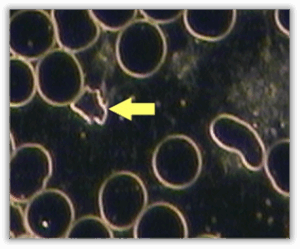
- Schistocytes are red blood cells that appear fragmented or irregularly shaped, often looking as though a portion of the cell has been broken or torn away. Instead of a smooth, rounded outline, these cells may appear angular, sharp-edged, or incomplete in form.
- In live blood analysis, it is not unusual to observe an occasional fragmented red blood cell. However, when multiple schistocyte-like cells are seen across several fields of view, it suggests a broader pattern rather than isolated mechanical change.
- The presence of schistocytes reflects red blood cells that have undergone physical stress within the circulating environment, highlighting a blood terrain where cell integrity and resilience may be challenged during circulation.
Appearance
- Schistocytes are fragmented red blood cells (RBCs) with very irregular shapes. They often appear jagged, helmet-like, or crescent-shaped. Schistocytes are commonly observed together with keratocytes, acanthocytes, and echinocytes in the same sample, indicating significant red cell membrane damage or fragmentation.
Pleomorphic Perspective
- These forms develop as a result of consumption of the erythrocyte’s material by the endobiont. Advanced phases of the endobiont can be observed in such samples, indicating severe oxidative terrain imbalance. Schistocytes reflect the destructive phase of pleomorphic progression where the RBC membrane has been consumed or fragmented.
Medical Perspective
- Schistocytes are the morphological hallmark of haemolytic anaemias associated with red cell fragmentation, such as microangiopathic haemolytic anaemia and haemolysis caused by cardiac prostheses. They are common in vascular lesions, disseminated intravascular coagulation (DIC), uraemia, severe burns, and mechanical trauma. They may also appear in pulmonary emboli, endocarditis, thrombotic thrombocytopenic purpura (TTP), malignant hypertension, and vasculitis.
Relevance
- Schistocytes are not usually observed in normal live blood samples. Their presence is significant and always warrants further investigation, as it suggests RBC fragmentation or mechanical trauma.
Implications
- Schistocytes are formed when normal RBCs are damaged by mechanical trauma. This is most often related to cardiac and vessel anomalies, as well as diseases of the small blood vessels with disturbance of the microcirculation.
- Microvascular disturbance (atherosclerosis, fibrin from liver disease, antigen-antibody reactions).
- Turbulent blood flow (hypertension, valvular dysfunction in the heart).
- Intrinsic erythrocyte abnormalities (severe iron deficiency, megaloblastic anaemia).
- Severe burns.
- Damage by the spleen (when old RBCs are broken down and a fragment escapes).
- Free radical activity from inhalation of toxic fumes, ingestion of toxins, stress, tobacco and coffee.
Associated Symptoms
- Fatigue
- Dizziness
- Weakness
- Poor circulation
- Possible hypertension or haemolysis
Interventions
Detox Protocol:
- Hepaton + Lymphlux + Nephrocil + HumiCaps + detox diet.
Supplements:
- Omega-3 supplement (1000–2000 EPA daily).
- Vitamin E: start with 400 mg daily and gradually increase to 800 mg.
- Buffered Vitamin C (2500 mg) and other antioxidants such as Super Oxide Dismutase, proanthocyanidins, and N-Acetyl Cysteine. – Selenium (200 µg), Beta-carotene, Zinc, and Glutathione.
- Vitamin B3 (Niacin) and Co-enzyme Q10 (Ubiquinol Co-Q10): 50 mg 2× daily
- Trace minerals: Bio-Ionic Minerals
- Chelated iron supplement if anaemic.
Working with
- Always determine the underlying cause by correlating clinically. Treatment should be directed toward the specific pathology, whether vascular, oxidative, or mechanical. Most schistocytes in live blood analysis are associated with blood vessel conditions and elevated homocysteine.
General Guidelines
- Increase water intake: Weight (kg) ÷ 8 × 0.25 = litres/day.
- Increase fibre-rich carbohydrates and raw polyunsaturated fats.
- Include raw vegetable juices, sprouts, greens, and antioxidant-rich superfoods.
- Avoid saturated fats, refined carbohydrates, and enzyme-deficient foods.
- Stop smoking
- Avoid alcohol, caffeine, sugar, drugs, and non-essential medication.
- Test and monitor blood pressure and cholesterol.
- Test and correct homocysteine levels.
Functional Systems Influenced
Hematological
Schistocytes reflect changes in red blood cell integrity, indicating that some cells have been physically altered as they circulate within the blood. This directly affects how red blood cells function and persist in the bloodstream.
Circulation & Hydration
Red blood cells are designed to move smoothly and flexibly through blood vessels. When circulating conditions place greater physical stress on cells, fragmentation may occur, influencing overall circulation quality, particularly in smaller vessels.
Cardiovascular
When red blood cells are exposed to increased mechanical forces within circulation, the cardiovascular system may need to work harder to maintain effective blood flow. Schistocytes reflect this increased circulatory strain rather than a primary heart issue.
Oxidative & Antioxidant Balance
Red blood cell membranes are sensitive to oxidative influences. Reduced oxidative balance may weaken membrane resilience, making cells more susceptible to damage during circulation.
Commonly Associated Terrain Imbalances
Acidic terrain
Shifts toward a more acidic internal environment can influence red blood cell membrane stability, increasing vulnerability to physical stress during circulation.
Dehydration / plasma viscosity ↑
Reduced plasma fluidity can increase friction and shear forces within the bloodstream, placing greater mechanical stress on red blood cells and increasing the likelihood of fragmentation.
Low antioxidant reserve
When antioxidant protection is limited, red blood cell membranes may be less resilient to everyday physical and environmental stressors, allowing damage to occur more readily.
Oxidative stress ↑
Oxidative influences can weaken membrane integrity, making red blood cells more susceptible to physical disruption as they circulate.
Protein intake / albumin low
Adequate plasma protein balance helps protect red blood cells from excessive mechanical stress. Reduced albumin availability may contribute to increased membrane vulnerability.
Supportive Focus & Awareness
-
Awareness of hydration and fluid balance, as adequate plasma fluidity supports smoother red blood cell circulation
-
Awareness of factors that influence red blood cell membrane resilience and integrity
-
Awareness of oxidative balance and everyday influences that may affect cellular stability
-
Awareness of circulation quality and the physical demands placed on red blood cells during movement through the bloodstream
-
Awareness of energy levels, stamina, and recovery, particularly during periods of increased physical or metabolic demand
Commonly Reported Experiences
- Some individuals whose blood patterns include fragmented red blood cells report general fatigue, weakness, or reduced stamina, particularly during periods of physical or mental demand. Dizziness or light-headedness is also sometimes mentioned.
- Circulation-related sensations may be reported, such as feeling cold in the hands or feet, or a sense that circulation is less efficient overall.
- In some cases, people describe experiences that prompt further attention to cardiovascular or blood health, particularly when similar patterns persist over time. These observations do not indicate a diagnosis but may encourage broader awareness and, where appropriate, discussion with a healthcare professional.
These experiences are non-specific and can be influenced by many factors. Their presence does not confirm any condition and should always be considered in the wider context of individual circumstances and other observations.
Systems / Body Functions
Cardiovascular, Circulation & Hydration, Hematological, Oxidative & Antioxidant Balance
Imbalances
Acidic terrain, Dehydration / plasma viscosity ↑, Low antioxidant reserve, Oxidative stress ↑, Protein intake/albumin low
- Schistocytes are red blood cells that appear fragmented or irregularly shaped, often looking as though a portion of the cell has been broken or torn away. Instead of a smooth, rounded outline, these cells may appear angular, sharp-edged, or incomplete in form.
- In live blood analysis, it is not unusual to observe an occasional fragmented red blood cell. However, when multiple schistocyte-like cells are seen across several fields of view, it suggests a broader pattern rather than isolated mechanical change.
- The presence of schistocytes reflects red blood cells that have undergone physical stress within the circulating environment, highlighting a blood terrain where cell integrity and resilience may be challenged during circulation.
These forms develop as a result of consumption of the erythrocyte’s material by the endobiont. Advanced phases of the endobiont can be observed in such samples, indicating severe oxidative terrain imbalance. Schistocytes reflect the destructive phase of pleomorphic progression where the RBC membrane has been consumed or fragmented.
 Disclaimer