You must be logged in to record observations.
Short Description
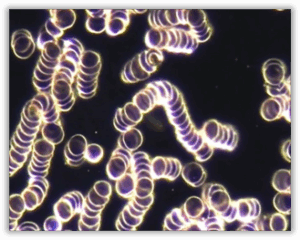
Rouleaux formation refers to red blood cells stacking together in linear chains, resembling a pile of coins rather than remaining evenly dispersed. This altered pattern reduces the normal flexibility and free movement of red blood cells within the plasma, changing how efficiently they can circulate through smaller vessels.
This appearance is commonly associated with increased plasma density or protein influence, which encourages cells to adhere to one another rather than repel. When present beyond a minimal degree, rouleaux suggests that the blood environment is under strain and that optimal flow and exchange may be compromised.
Observing rouleaux is significant because it reflects a shift away from fluid, responsive blood dynamics toward a more sluggish terrain, which can influence oxygen delivery and overall circulatory efficiency.
Pleomorphic Perspective
The primary parasitic element of the blood, the endobiont, in its higher forms merges RBC membranes, causing rouleau. High-valence microorganisms copulate between adjacent cells. Rouleau correlates with increased ESR and blood viscosity. Mucor racemosus Fresen (the ‘congester’) raises viscosity and coagulation. Stuck RBCs create nutrient pockets for endobiont growth. Pressurizing the coverslip can rupture cells, releasing higher growth forms hidden in or on RBCs.
Medical Perspective
Peripheral blood smears show rouleau when ESR is raised, a non-specific inflammation marker. ESR depends on the balance between fibrinogen (sedimentation promoter) and zeta potential (resistor). In inflammation, increased fibrinogen and globulins cause RBCs to clump and settle faster. Severe rouleau may impair capillary flow, reducing gas exchange and causing local hypoxia, acidosis, and fatigue. Causes include anaemia, infection, allergy, trauma, and lymphoproliferative disorders.
Relevance
The zone of aggregation at the periphery of the sample will exhibit a marked degree of rouleaux (usually with precipitated fibrin). This is a normal finding caused by the slide and coverslip and is not relevant. To establish the presence of true rouleau one should scan through the whole sample at a low level of magnification, observing the degree and extent of rouleaux in the working area of the sample. If rouleaux is consistently observed in more than 50% of the working area of the sample the finding is significant. The degree of overlapping may also vary from loosely stacked cells (mild rouleau) to very tightly stacked cells (severe rouleaux)
Implications
- The stickiness of RBCs is due to the appearance of increased serum proteins, often the acute phase proteins such as fibrinogen and immunoglobulins. This process begins with protein linkage (mild stickiness), through rouleaux (moderate stickiness) to erythrocyte aggregation (severe stickiness). The zeta potential (negative charge on the surface of the RBCs) is lost due to positively charged proteins attaching to the RBC membranes, rendering them “sticky”.
- An over-acidic pH will also lead to rouleaux. When the pH is too acidic, the natural polarity of the cell is reversed, which disturbs the zeta potential.
- A trace mineral deficiency and electrolyte imbalance is central to the development of the disturbed pH. Trace mineral deficiency also results in inadequate production of enzymes. This then leads to digestive insufficiency, poor nutrient absorption and transfer at the cellular level, leading to toxicity and excess nutrients in the bloodstream.
- Rouleaux can be observed in a number of clinical disease settings, including inflammation, infection, chronic liver disease (with hypergammaglobulinaemia), alcoholism and dehydration.
- In blood analysis rouleau is regarded as a sign of digestive imbalance and intestinal stress, due to a wide range of digestive challenges, including:
- An unbalanced diet
- Inadequate digestive enzymes,
- Deficient intestinal flora (intestinal dysbiosis),
- Bowel toxicity,
- Food sensitivities,
- Eating the wrong foods for the blood type, e.g. wheat consumption by type O’s, beef consumption by type A’s, etc.
- Often observed in irritable bowel syndrome & colitis.
- Can be an indication of severe degenerative disease.
- May be related to stress & increased cortisol levels (look for RBC rings)
- Dehydration, not drinking enough water.
Associated Symptoms
- Poor appetite or a heavy/bloated sensation after eating or getting full very quickly.
- Heartburn, indigestion or reflux after eating.
- Abdominal discomfort, bloating, flatulence, especially getting worse during the course of the day.
- Constipation / diarrhoea.
- Patients with significant rouleaux usually complain of fatigue, shortness of breath and signs of poor circulation (cold hands and feet, tingling or numbness). This is because the RBCs’ ability to pass through the tiny capillaries in single file is severely compromised when they are stacked on top of each other. The available surface area for the exchange of gases is also significantly reduced.
Interventions
Any combination of the following, depending on the rest of the case:
DIGESTIVE PROTOCOL:
- Digestal + NeoFlora + Bio-Ionic Mineral Concentrate (Neogenesis Health Products).
ACIDITY PROTOCOL:
- Alkazen + Bio-lonic Mineral Concentrate (Neogenesis Health Products) + alkaline-forming diet.
INFLAMMATION PROTOCOL:
- HumiCaps: 2-4 capsules 2-4x daily.
- Curcumigen: 1 capsule 1-2x daily.
- Glutathione 500 : 1 capsule 1-2x daily.
- Trace minerals: Bio-lonic Minerals
- Omega-3 supplement (1000-2000 EPA daily).
SUPPLEMENTS:
- Digestive Enzymes
- Omega-3 supplement (1000-2000 EPA daily).
- Vitamin B3, as non-flush Niacin (1000mg daily). Niacin helps to remove excess protein and saturated fat from the blood and stimulates hydrochloric acid production by the stomach.
Working with
The majority of clients displaying rouleau have some digestive imbalance and digestive symptoms. Always ask the client about their digestive system and whether they experience any digestive symptoms. Where symptoms can not be elicited, correlate with other signs to determine the underlying imbalance (this will most likely still be a digestive imbalance even if they are asymptomatic). Although rouleau may be an indication of advanced degenerative disease, the approach is usually to first attempt to re-establish the correct terrain through nutritional interventions. These include dietary changes (as listed above), Digestal, NeoFlora and Bio-lonic Minerals. Digestive enzymes and vitamin B3.may also be helpful. However, if the condition persists, consider further conventional investigations.
General Guidelines
- Moderate, or exclude, animal protein intake, aiming for balanced portions appropriate to body size and activity level
-
Avoid heavy or complex meal combinations; eat slowly, seated, and chew thoroughly to support digestive efficiency
-
Where relevant, consider individualised nutritional approaches that recognise biochemical uniqueness
-
Be mindful of potential food sensitivities or intolerances that may influence systemic balance
-
Increase water intake → Weight (kg) ÷ 8 × 0.25 = litres/day (2-3 litres is the average)
-
Emphasise fibre-rich carbohydrates, leafy greens, sprouts, raw or lightly processed vegetables, and antioxidant-rich whole foods
-
Reduce reliance on highly processed foods, refined carbohydrates, and excessive saturated fats
-
Minimise or avoid smoking, alcohol, excess caffeine, refined sugar, and unnecessary chemical exposure where possible
Functional Systems Influenced
Hematological
Rouleaux reflects a change in how red blood cells interact with one another, forming linear stacks rather than remaining evenly separated. This directly influences blood behaviour and cell-to-cell interaction within the bloodstream.
Circulation & Hydration
Stacked red blood cells move less freely through the microcirculation, particularly in narrow vessels. This can reduce circulation efficiency, especially when fluid balance is suboptimal.
Cardiovascular
When red blood cells aggregate into rouleaux formations, blood flow resistance may increase. This can place additional demand on the cardiovascular system to maintain adequate circulation, particularly during physical or metabolic stress.
Oxidative & Antioxidant Balance
Oxidative influences can affect plasma proteins and red blood cell surface properties, increasing the tendency for cells to adhere and form rouleaux patterns.
Commonly Associated Terrain Imbalances
Acidic terrain
Shifts toward a more acidic internal environment can influence plasma charge and red blood cell surface interactions, increasing the tendency for cells to stack together.
Dehydration / plasma viscosity
Reduced fluid volume can concentrate plasma contents, making red blood cells more likely to adhere and form linear stacks rather than remaining evenly dispersed.
Hepatic overload
The liver plays a key role in managing circulating proteins and plasma composition. When processing capacity is strained, plasma changes may favour increased red blood cell adhesion.
Low antioxidant reserve
Reduced antioxidant protection can allow oxidative influences to persist, affecting plasma quality and increasing red blood cell stickiness.
Oxidative stress
Oxidative influences can modify plasma proteins and red blood cell surfaces, increasing the likelihood of rouleaux formation.
Protein intake / albumin low
Imbalances in plasma protein composition, particularly reduced albumin, can alter normal cell separation and encourage stacking behaviour.
Supportive Focus & Awareness
- Awareness of hydration status and how fluid balance influences blood thickness and red blood cell separation
-
Awareness of factors that affect plasma quality, including how proteins behave within circulation
-
Awareness of liver function as it relates to maintaining balanced plasma composition
-
Awareness of oxidative balance and everyday influences that affect blood fluidity
-
Awareness of circulation efficiency, particularly in smaller vessels where smooth blood flow is essential
Commonly Reported Experiences
- Some individuals whose blood patterns include rouleaux report digestive-related experiences, particularly around meals. These may include a reduced appetite, feeling full more quickly than expected, or a heavy or bloated sensation after eating.
- Others describe upper digestive discomfort such as indigestion, reflux, or heartburn following meals. Lower digestive experiences may also be reported, including abdominal bloating, flatulence, or general discomfort that tends to increase as the day progresses. Changes in bowel regularity, such as constipation or diarrhoea, are also sometimes mentioned.
- When rouleaux patterns are more pronounced, some individuals report feeling fatigued or experiencing reduced stamina. Circulation-related sensations, such as feeling cold in the hands or feet, breathlessness on exertion, or tingling or numbness in the extremities, are also sometimes described.
These experiences are non-specific and can be influenced by many factors. They do not confirm any condition and should always be considered alongside individual circumstances and other observations.
Systems / Body Functions
Cardiovascular, Circulation & Hydration, Hematological, Oxidative & Antioxidant Balance
Imbalances
Acidic terrain, Dehydration / plasma viscosity ↑, Hepatic overload, Low antioxidant reserve, Oxidative stress ↑
Rouleaux formation refers to red blood cells stacking together in linear chains, resembling a pile of coins rather than remaining evenly dispersed. This altered pattern reduces the normal flexibility and free movement of red blood cells within the plasma, changing how efficiently they can circulate through smaller vessels.
This appearance is commonly associated with increased plasma density or protein influence, which encourages cells to adhere to one another rather than repel. When present beyond a minimal degree, rouleaux suggests that the blood environment is under strain and that optimal flow and exchange may be compromised.
Observing rouleaux is significant because it reflects a shift away from fluid, responsive blood dynamics toward a more sluggish terrain, which can influence oxygen delivery and overall circulatory efficiency.
The primary parasitic element of the blood, the endobiont, in its higher forms merges RBC membranes, causing rouleau. High-valence microorganisms copulate between adjacent cells. Rouleau correlates with increased ESR and blood viscosity. Mucor racemosus Fresen (the 'congester') raises viscosity and coagulation. Stuck RBCs create nutrient pockets for endobiont growth. Pressurizing the coverslip can rupture cells, releasing higher growth forms hidden in or on RBCs.
 Disclaimer