You must be logged in to record observations.
Short Description
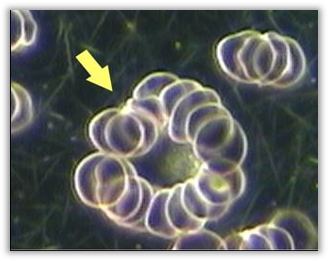
- RBC rings describe a pattern in which red blood cells are observed arranged into closed, circular formations, forming ring-like structures within the live blood sample. Rather than remaining evenly separated or stacking in linear chains, the red blood cells organise into rounded loops or enclosed shapes.
- These ring formations are created by strings of red blood cells joining end-to-end, producing a circular or spiral configuration. The pattern may involve a small group of cells or extend across a larger area of the sample, depending on the surrounding blood environment.
- The presence of RBC rings reflects an alteration in how red blood cells interact with one another, highlighting a blood terrain where cell-to-cell adhesion and plasma conditions are influencing collective red blood cell behaviour rather than individual cell shape.
Appearance
Strings of RBCs are observed in the live blood sample, arranged into closed rings.
Pleomorphic Perspective
The primary parasitic element of the blood, the endobiont, possesses an inherent urge to merge, pulling RBCs together. Copulation between high-valence microorganisms on adjacent RBC membranes accounts for this morphology.
Medical Perspective
This anomaly is not observed in stained blood samples.
Relevance
RBC rings are not usually observed in normal live blood samples. This finding is significant when seen during analysis.
Implications
Increased cortisol levels, due to increased stress levels, or in association with:
- Caffeine
- Sleep deprivation
- Intense or prolonged physical exercise
- Hypoestrogenism and melatonin supplementation in postmenopausal women
- Hyperthyroidism
- Cortisone-based medication
- Burnout
- Severe trauma or stressful events
- Anorexia nervosa
- Cushing’s syndrome, due to tumours of the pituitary gland, adrenal glands, and certain forms of cancer, such as small cell lung cancer.
- Commuting increases cortisol levels relative to the length of the trip, its predictability and the amount of effort involved
- Stimuli associated with sexual intercourse
- Severe calorie restriction
Associated Symptoms
- Weight gain
- Water retention
- Easy bruising
- Anxiety
- Difficulty breathing
- Insomnia
- Recurrent infections
- Blood sugar imbalance
- May also be asymptomatic
Interventions
Adrenal Protocol:
- Adrenin + Bio-Ionic Minerals
- DHEA: 25 mg initially, gradually increasing to 100 mg daily
Supplements:
- Vitamin B-Complex – L-Theanine: 300 mg twice daily
- 5-HTP
- Calcium & Magnesium
Working with
- Investigate the source of stress and apply suitable remedies. Medication alone will not resolve this condition if the underlying stress is unaddressed. For patients unresponsive to natural interventions, further testing is indicated.
General Guidelines
- Reduce mental and emotional stress through coping interventions.
- Address physical stress (inflammation, infection, trauma, overtraining) as appropriate.
- Increase water intake: Weight (kg) ÷ 8 × 0.25 = litres/day.
- Include raw vegetable juices, sprouts, greens, and antioxidant-rich superfoods.
- Avoid saturated fats, refined carbohydrates, and enzyme-deficient foods.
- Stop smoking.
- Avoid alcohol, caffeine, and stimulants.
Functional Systems Influenced
Hematological
RBC rings reflect a change in how red blood cells interact with one another within the blood. Rather than remaining evenly dispersed, cells form organised circular groupings, highlighting altered cell-to-cell behaviour within circulation.
Circulation & Hydration
Efficient circulation depends on red blood cells moving freely and independently. When cells form closed ring structures, this suggests reduced separation and altered flow dynamics, particularly within the microcirculation.
Cardiovascular
Patterns that increase red blood cell clustering can influence overall blood flow resistance. RBC rings may reflect increased circulatory demand rather than a primary cardiovascular condition.
Oxidative & Antioxidant Balance
Oxidative influences can affect plasma proteins and red blood cell surface properties, increasing cellular stickiness and encouraging organised aggregation patterns such as ring formation.
Commonly Associated Terrain Imbalances
Acidic terrain
Shifts toward a more acidic internal environment can influence red blood cell surface charge, increasing the tendency for cells to adhere and organise into closed ring formations.
Dehydration / plasma viscosity
Reduced plasma fluidity can concentrate blood components, encouraging red blood cells to cluster and maintain organised contact rather than remaining freely separated.
Hepatic overload
The liver plays a key role in managing plasma proteins and blood composition. When protein handling is altered, red blood cell interactions may increase, contributing to structured aggregation patterns such as rings.
Low antioxidant reserve
Reduced antioxidant protection can allow subtle changes in plasma and cell surface properties, increasing cellular stickiness and organised clustering.
Oxidative stress
Oxidative influences may affect red blood cell membranes and plasma proteins, encouraging stronger cell-to-cell attraction and sustained ring formation.
Protein intake / albumin low
Imbalances in plasma protein composition, particularly reduced albumin, can alter normal red blood cell separation and promote organised aggregation patterns.
Supportive Focus & Awareness
-
Awareness of hydration and fluid balance, as adequate plasma fluidity supports healthy red blood cell separation
-
Awareness of factors that influence plasma quality and red blood cell interaction within circulation
-
Awareness of circulation efficiency, particularly at the microcirculatory level where organised clustering may affect flow
-
Awareness of oxidative balance and everyday influences on cell-to-cell adhesion
-
Awareness of overall energy levels and stamina during periods of physical or metabolic demand
Commonly Reported Experiences
- Some individuals whose blood patterns include RBC ring formations report changes in body composition or fluid balance, such as gradual weight gain or increased water retention. Easy bruising is also sometimes mentioned.
- Others describe experiences related to energy regulation or stress response, including anxiety, disrupted sleep patterns, or difficulty maintaining restful sleep. In some cases, people report feeling short of breath or noticing breathing feels more laboured during exertion.
- Changes in immune resilience or metabolic balance are also sometimes described, including recurrent minor infections or fluctuations in blood sugar regulation. These experiences can vary widely in presentation and intensity.
- It is also important to note that RBC rings may be observed in individuals who do not report any noticeable symptoms and otherwise feel well.
These experiences are non-specific and can be influenced by many factors. Their presence does not confirm any condition and should always be considered in the broader context of individual circumstances and other observations.
Systems / Body Functions
Cardiovascular, Circulation & Hydration, Hematological, Oxidative & Antioxidant Balance
Imbalances
Acidic terrain, Dehydration / plasma viscosity ↑, Hepatic overload, Low antioxidant reserve, Oxidative stress ↑, Protein intake/albumin low
- RBC rings describe a pattern in which red blood cells are observed arranged into closed, circular formations, forming ring-like structures within the live blood sample. Rather than remaining evenly separated or stacking in linear chains, the red blood cells organise into rounded loops or enclosed shapes.
- These ring formations are created by strings of red blood cells joining end-to-end, producing a circular or spiral configuration. The pattern may involve a small group of cells or extend across a larger area of the sample, depending on the surrounding blood environment.
- The presence of RBC rings reflects an alteration in how red blood cells interact with one another, highlighting a blood terrain where cell-to-cell adhesion and plasma conditions are influencing collective red blood cell behaviour rather than individual cell shape.
The primary parasitic element of the blood, the endobiont, possesses an inherent urge to merge, pulling RBCs together. Copulation between high-valence microorganisms on adjacent RBC membranes accounts for this morphology.
 Disclaimer