You must be logged in to record observations.
Short Description
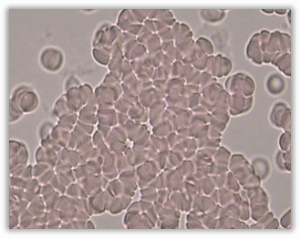
Red blood cell aggregation refers to the tendency of red blood cells to cluster together in groups rather than remaining evenly dispersed within the plasma. Unlike linear stacking patterns, aggregation often appears as irregular clumps, which can interfere with smooth blood flow at the microcirculatory level.
When aggregation is present, red blood cells may move less freely through smaller vessels, reducing circulation efficiency and limiting effective exchange with surrounding tissues. This clustering reflects changes in the plasma environment that encourage cells to adhere rather than repel.
The significance of aggregation lies in its impact on blood fluidity. Increased cell clustering suggests a terrain where circulation may be more sluggish, making it harder for oxygen and nutrients to be delivered efficiently.
Appearance
Large numbers of RBCs randomly piled on top of one another. Also referred to as clumping or ‘blood sludge’ as the cells are severely agglutinated. Erythrocyte aggregation can be distinguished from rouleau in that rouleaux are arranged linearly, whereas the RBCs in aggregation are stuck together in a 3-dimensional pattern.
Pleomorphic Perspective
The primary parasite’s urge to merge pulls RBCs, WBCs, and platelets together for propagation. This creates a culturing ground for parasites to advance through life phases. Under darkfield, the process becomes visible as endobionts evolve upwards when the terrain is acidic. Such a terrain, created by poor diet and lifestyle, promotes further upward evolution of endobionts. The acidic environment maintains pH imbalance as the endobiont secretes acids — lactic acid (by Mucor) and citric acid (by Aspergillus).
Medical Perspective
Red cell sludging (agglutinated erythrocytes) may occur due to altered cell membranes, allowing adherence to adjacent cells. Lipoproteins, fats (including arachidonic acid), and acute phase proteins are implicated in blood sludge formation. Myocardial infarction, angina, neoplastic and atherosclerotic processes, and venous thrombosis correlate with severe aggregation. High blood viscosity from aggregation can affect patient survival, with reductions in sludging improving prognosis.
Relevance
RBC aggregation at the periphery of the sample is ignored. It becomes significant when it occurs in the working area of the sample. When a honeycomb pattern is observed in the working area, it is regarded as a serious indication of aggregation.
Implications
- This is a more severe finding than protein linkage or rouleau and may be related to numerous degenerative conditions. Due to the severe aggregation the blood cannot flow and thereby forces damage to the circulatory system and organs.
- The stickiness of RBCs is due to the appearance of increased serum proteins, often the acute phase proteins such as fibrinogen and immunoglobulins. This process begins with protein linkage (mild stickiness), through rouleau (moderate stickiness) to erythrocyte aggregation (severe stickiness). The zeta potential (negative charge on the surface of the RBCs) is lost due to positively charged proteins attaching to the RBC membranes, rendering them “sticky”.
- Erythrocyte aggregation can be observed in a number of clinical disease settings, including inflammation, infection, chronic liver disease (with hypergammaglobulinaemia), alcoholism and dehydration.
- In blood analysis erythrocyte aggregation is regarded as a sign of severe and chronic over-acidity and toxicity.
- The pH is too acidic, thereby reversing the natural polarity of the cell. When the negative charge of the RBC surface (Zeta potential) is disturbed, the RBCs attract rather than repel each other.
- A trace mineral deficiency and electrolyte imbalance is central to the development of the disturbed pH. Trace mineral deficiency also results in inadequate production of enzymes. This then leads to digestive insufficiency, poor nutrient absorption and transfer at the cellular level, leading to toxicity and excess nutrients in the bloodstream.
- Erythrocyte aggregation is observed in patients with damage to the microvascalature.
- Regarded as a very toxic condition, due to long term stress, coffee, meat, drugs (prescription & recreational), cigarettes, poor elimination, etc.
- Increased dietary ingestion of saturated, animal protein and enzyme deficient foods.
- Hypercholesterolemia
- Dehydration, not drinking enough water.
Associated Symptoms
Patients with erythrocyte aggregation usually complain of fatigue, shortness of breath, and poor circulation (cold hands/feet, cramps, tingling, numbness). This occurs because RBCs’ ability to pass through capillaries in single file is severely compromised, reducing gas exchange. Blood sludge can lead to clotting and occlusive vascular disease.
Interventions
Any combination of the following, depending on the rest of the case:
DETOX PROTOCOL:
- Hepaton + Lymphlux + Nephrocil + HumiCaps + detox diet.
ACIDITY PROTOCOL:
- Alkazen + Bio-lonic Minerals + alkaline-forming diet.
DIGESTIVE PROTOCOL:
- Digestal + NeoFlora + Bio-Ionic Minerals
SUPPLEMENTS:
- Omega-3 supplement (1000-2000 EPA daily).
- Vitamin E: start with 400mg daily and gradually increase to 800mg daily.
- Buffered vitamin C (2500mg) and/or other antioxidants such as: Super Oxide Dismutase, proanthocyanidins, N-Acetyl Cysteine, selenium (200ug), beta carotene, zinc and glutathione.
- Vitamin B3, as non-flush Niacin (1000mg daily). Niacin helps to remove excess protein and saturated fat from the blood and stimulates hydrochloric acid production by the stomach.
Working with
This condition may indicate serious pathology and should be approached with caution. If present, priority should be detoxification and pH correction. Aggregation is often seen with renal urea, fibrin, poikilocytes, and other crystals. If unresponsive to nutritional intervention, further clinical tests are required.
General Guidelines
- Limit dietary animal protein to 1 g/kg body weight per day.
- Avoid combining protein and starch in the same meal.
- Sit and chew food properly; eat calmly.
- Follow diet per blood type.
- Avoid hidden food sensitivities.
- Increase water: Weight (kg) ÷ 8 × 0.25 = daily litres.
- Emphasize fibre, sprouts, greens, and raw superfoods.
- Avoid refined carbohydrates and processed fats.
- Stop smoking, avoid alcohol, caffeine, sugar, and non-essential medication.
Functional Systems Influenced
Hematological
Aggregation reflects how red blood cells interact with one another within the blood itself. When clustering is present, it indicates that normal separation and movement of red blood cells is being influenced by the surrounding plasma environment.
Circulation & Hydration
Efficient circulation relies on red blood cells flowing smoothly through even the smallest vessels. Aggregation can reduce this efficiency, making circulation more sluggish and less responsive to the body’s needs.
Oxidative & Antioxidant Balance
Oxidative influences can affect both plasma quality and cell surfaces, altering how red blood cells repel or attract one another. When balance is reduced, cells may be more likely to cluster.
Commonly Associated Terrain Imbalances
Dehydration / plasma viscosity
When fluid levels are low, the plasma becomes more concentrated, increasing friction between cells. This makes it easier for red blood cells to come into contact and remain clustered together.
Protein intake / albumin low
Plasma proteins help maintain proper separation between red blood cells. Reduced protein availability can alter this balance, allowing cells to adhere more readily.
Oxidative stress
Oxidative pressure can subtly change the surface characteristics of red blood cells and plasma, reducing natural repulsion and encouraging clustering.
Low antioxidant reserve
Without sufficient antioxidant support, oxidative influences may persist, increasing the likelihood that red blood cells will aggregate rather than flow freely.
Acidic terrain
A more acidic internal environment can influence electrical charge and plasma balance, making red blood cell clustering more likely.
Supportive Focus & Awareness
-
Awareness of hydration and fluid balance, as adequate plasma fluidity supports healthy red blood cell separation
-
Awareness of factors that influence plasma quality, including protein balance within the circulating blood
-
Awareness of circulation efficiency, particularly at the microcirculatory level where red blood cells normally move freely
-
Awareness of oxidative balance and everyday influences that may affect blood fluidity and cell interaction
-
Awareness of overall energy levels, stamina, and recovery, especially during periods of physical or metabolic demand
Commonly Reported Experiences
- Some individuals whose blood patterns include erythrocyte aggregation report feeling fatigued or experiencing reduced stamina, particularly during physical exertion or prolonged activity. Others may notice becoming short of breath more easily than expected.
- Circulation-related sensations are also sometimes described, such as cold hands or feet, muscle cramps, tingling, or numbness in the extremities. These experiences are often reported in situations where circulation efficiency feels reduced.
These experiences are non-specific and can be influenced by many factors, including hydration, activity level, stress, and overall health. Their presence does not confirm any condition and should always be considered in the broader context of individual circumstances and other observations.
Systems / Body Functions
Circulation & Hydration, Hematological, Oxidative & Antioxidant Balance
Red blood cell aggregation refers to the tendency of red blood cells to cluster together in groups rather than remaining evenly dispersed within the plasma. Unlike linear stacking patterns, aggregation often appears as irregular clumps, which can interfere with smooth blood flow at the microcirculatory level.
When aggregation is present, red blood cells may move less freely through smaller vessels, reducing circulation efficiency and limiting effective exchange with surrounding tissues. This clustering reflects changes in the plasma environment that encourage cells to adhere rather than repel.
The significance of aggregation lies in its impact on blood fluidity. Increased cell clustering suggests a terrain where circulation may be more sluggish, making it harder for oxygen and nutrients to be delivered efficiently.
The primary parasite’s urge to merge pulls RBCs, WBCs, and platelets together for propagation. This creates a culturing ground for parasites to advance through life phases. Under darkfield, the process becomes visible as endobionts evolve upwards when the terrain is acidic. Such a terrain, created by poor diet and lifestyle, promotes further upward evolution of endobionts. The acidic environment maintains pH imbalance as the endobiont secretes acids — lactic acid (by Mucor) and citric acid (by Aspergillus).
 Disclaimer