You must be logged in to record observations.
Short Description
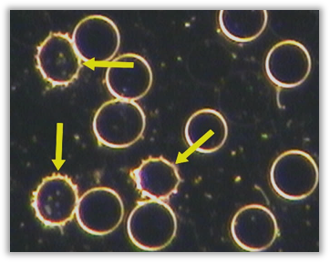
Echinocytes are red blood cells that display multiple small, evenly spaced projections around their outer surface, giving the cell a spiky or crenated appearance. Unlike irregular or fragmented cells, these projections are usually uniform in size and distributed consistently around the cell membrane.
In live blood analysis, it is not unusual to observe an occasional echinocyte within a field of view, particularly if the sample has been exposed to mild environmental influences. However, when a noticeable proportion of red blood cells show this crenated appearance across multiple fields, it suggests a broader pattern rather than an isolated change.
The presence of echinocytes reflects an alteration in red blood cell surface behaviour, indicating that the surrounding plasma environment or membrane conditions are influencing how red blood cells maintain their usual smooth, flexible shape.
Appearance
Smaller RBCs with many regular, small, sharp spikes evenly distributed across the cell surface. Also known as ‘burr cells’ or ‘berry cells’. The process through which normal RBCs become echinocytes can be compared to a grape shrivelling up to become a sultana. Oxidative damage to the RBC leads to a breakdown in energy production pathways within the cell. As a consequence, the cell loses its ability to control fluid, leading to loss of intracellular water (crenation).
Pleomorphic Perspective
These forms occur when ascits develop within the interior of the RBC and penetrate the membrane. This pathological condition reflects accumulated toxins and endobiontic progression damaging blood cells. Antioxidants may protect against free radical damage, but not from the endobiont, which is indestructible and will persist and increase in valence as long as the body terrain allows.
Medical Perspective
Echinocytosis (crenated erythrocytes) is usually not an indicator of a pathological problem but is often an artefact. Echinocytes can also form in vitro at high pH or in the presence of high calcium concentrations, exposure to glass surfaces, reduced albumin concentrations, and after prolonged storage. They are observed in end-stage renal and liver disease. In liver disease, abnormal high-density lipoprotein binds to receptors on the red cell membrane, inducing conformational changes. Echinocytosis also appears in acute blood loss, stomach cancer, and pyruvate kinase deficiency.
Relevance
Some degree of echinocytosis will be present in all samples. This finding becomes more significant when observed in greater numbers – exceeding 1% of the live blood specimen.
Echinocytes are a relevant finding in live blood analysis because they reflect a change in red blood cell surface structure rather than internal cell content. Their appearance suggests that the conditions surrounding the red blood cells are influencing how the cell membrane behaves within circulation.
Relevance increases when echinocytes are observed consistently across multiple fields of view, or when they appear alongside other plasma or red blood cell surface patterns. In these cases, the pattern is more likely to reflect a broader environmental influence within the blood rather than a temporary or isolated change.
Implications
This condition can be an artefact if the blood is damaged from being overexposed to ambient air or pressurized.
- Kidney stress
- Uraemia, related to kidney disease (kidney failure).
- Vitamin E deficiency
- Fluid: Electrolyte imbalance / Dehydration
- Some prescription drugs (that influence fluid-electrolyte balance or cause kidney stress)
- Oxidative damage (toxicity)
- Environmental toxins
- Snake and bee venom
- lonizing radiation
Associated Symptoms
- Fatigue
- A myriad of symptoms related to toxicity (headaches, malaise, skin conditions, etc.)
- Thirst, Cramps and signs of dehydration.
Interventions
Any combination of the following, depending on the rest of the case:
KIDNEY PROTOCOL:
- Potassium supplement if kidney stress is suspected (correlate clinically).
- Nephrocil: 30 drops tincture 3x daily. May be increased to 5ml tincture 3xdaily.
- Reduce animal protein and acid-forming foods.
DETOX PROTOCOL:
- Hepaton + Lymphlux + Nephrocil + HumiCaps + detox diet.
SUPPLEMENTS:
- Vitamin E: start with 400mg daily and gradually increase to 800mg daily.
- Antioxidants such as: Super Oxide Dismutase, proanthocyanidins, N-Acetyl Cysteine, buffered vitamin C, selenium (200ug),
- beta carotene, zinc and glutathione.
- Trace minerals: Bio-lonic Minerals
General Guidelines
- Increase water intake. To determine necessary daily water intake (in litres): Weight (kg) / 8) x 0.25.
- Increase intake of fibre-rich carbohydrates (those tolerated by the blood type) and raw, polyunsaturated fats.
- Raw vegetable juices, sprouts, greens and antioxidant-rich superfoods.
- Avoid saturated fat, refined carbohydrates and food deficient in natural enzymes.
- Smokers: stop smoking
- Avoid alcohol, caffeine, sugar, drugs and non-essential medication.
Functional Systems Influenced
Hematological
Echinocytes represent a change in red blood cell surface structure, directly affecting how red blood cells behave within the bloodstream. Alterations in membrane shape can influence cell flexibility and interaction with the surrounding plasma.
Circulation & Hydration
Red blood cells rely on adequate fluid balance to maintain a smooth, flexible shape. When hydration or plasma conditions are less optimal, surface changes such as crenation may occur, influencing how efficiently cells move through the microcirculation.
Oxidative & Antioxidant Balance
Red blood cell membranes are sensitive to oxidative influences. Reduced oxidative balance may affect membrane stability, making surface projections more likely to form and persist.
Commonly Associated Terrain Imbalances
Acidic terrain
Shifts toward a more acidic internal environment can influence red blood cell membrane charge and stability, increasing the likelihood of surface crenation.
Dehydration / plasma viscosity
Reduced plasma fluidity can alter cell–plasma interactions, making red blood cells more prone to developing evenly spaced surface projections.
Low antioxidant reserve
When antioxidant protection is limited, red blood cell membranes may be less resilient to everyday environmental influences, allowing surface changes to persist.
Oxidative stress
Oxidative influences can affect membrane integrity and flexibility, contributing to the formation of crenated red blood cells.
Supportive Focus & Awareness
-
Awareness of hydration and fluid balance as they relate to red blood cell shape and circulation quality
-
Awareness of factors that influence red blood cell membrane flexibility and stability
-
Awareness of oxidative balance and everyday influences on cellular resilience
-
Awareness of circulation efficiency, particularly at the microcirculatory level
-
Awareness of energy levels and recovery during periods of physical or metabolic demand
Commonly Reported Experiences
- Some individuals whose blood patterns include echinocytes report feeling fatigued or experiencing reduced stamina, particularly during periods of increased physical or mental demand.
- Others describe a range of general, non-specific experiences often associated with feeling overloaded or unwell, such as headaches, a sense of malaise, or changes in skin appearance. These experiences are broad and can be influenced by many internal and environmental factors.
- In some cases, sensations related to fluid balance are also reported, including increased thirst, muscle cramps, or other signs commonly associated with reduced hydration.
- These experiences are non-specific and vary widely between individuals. Their presence does not confirm any condition and should always be considered in the broader context of personal circumstances and other observations.
Systems / Body Functions
Circulation & Hydration, Hematological, Oxidative & Antioxidant Balance
Imbalances
Acidic terrain, Dehydration / plasma viscosity ↑, Low antioxidant reserve, Oxidative stress ↑
Echinocytes are red blood cells that display multiple small, evenly spaced projections around their outer surface, giving the cell a spiky or crenated appearance. Unlike irregular or fragmented cells, these projections are usually uniform in size and distributed consistently around the cell membrane.
In live blood analysis, it is not unusual to observe an occasional echinocyte within a field of view, particularly if the sample has been exposed to mild environmental influences. However, when a noticeable proportion of red blood cells show this crenated appearance across multiple fields, it suggests a broader pattern rather than an isolated change.
The presence of echinocytes reflects an alteration in red blood cell surface behaviour, indicating that the surrounding plasma environment or membrane conditions are influencing how red blood cells maintain their usual smooth, flexible shape.
These forms occur when ascits develop within the interior of the RBC and penetrate the membrane. This pathological condition reflects accumulated toxins and endobiontic progression damaging blood cells. Antioxidants may protect against free radical damage, but not from the endobiont, which is indestructible and will persist and increase in valence as long as the body terrain allows.
 Disclaimer