You must be logged in to record observations.
Short Description
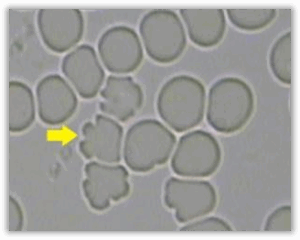
- Cloud patterns describe red blood cells that develop soft indentations or contours resembling cloud-like shapes. Rather than having a smooth, rounded outline, the affected red blood cells appear gently sculpted, sometimes forming ridge-like patterns that can be seen across many cells within the same area of the sample, or occasionally affecting single red blood cells in isolation.
- In darkfield observation, fine fibrin structures may sometimes be seen surrounding these cloud-shaped red blood cells. These fibrin formations can appear as delicate, needle-like strands that press against the red blood cell membrane, temporarily altering the cell’s shape.
- The key feature of cloud patterns is that the shape change is reversible. When the red blood cell moves away from the nearby fibrin influence, it typically returns to its original, rounded form. This distinguishes cloud patterns from permanent structural changes in red blood cells and highlights their dynamic, environment-dependent nature.
Appearance
RBCs with indentations appearing similar to cloud drawings. These may appear as a ‘ridge’, affecting many RBCs over a large area in the sample or as single RBCs. Fibrin clusters may be observed surrounding the cloud patterns in darkfield. These needles of precipitated fibrin push into the cell membranes, changing the shape of the RBCs. The change in shape is only temporary and dependent on the fibrin needle pushing into the RBC. Should the RBC move away from the fibrin it will return to its original shape.
Pleomorphic Perspective
These forms develop due to the presence of fibrin in the plasma. Fibrin spicules are excess pathogenic colloids that have accumulated in the body and have arranged themselves linearly. This is the chondroid-dendrite form of the endobiont. The earlier, apathogenic filit-phase of the Mucor cycle is involved with normal clotting. The thicker, higher valence forms are found in the pathogenic part of the cycle, often with coccoidal forms like chondrits in the plasma or within RBCs. The thicker the filit, the higher the valence of the accumulated colloids and the more pathogenic the condition is.
Medical Perspective
These abnormal morphologies are not observed in stained blood samples.
Relevance
These are considered relevant when observed to any degree in a sample.
Implications
- The presence of cloud patterns indicates inflammation.
- This anomaly is a sensitive indicator for inflammation and is due to mild inflammation when no other parameters for inflammation (rouleau, fibrin clusters, diffuse fibrin spicules, platelet aggregation or spherocytes) are observed.
- Any condition associated with inflammation: arthritis, sinusitis, rhinitis, colitis, etc.
- Latent acidosis (an acidic pH facilitates inflammation).
- Trace mineral deficiency.
- Raised homocysteine levels (in cases where cloud patterns are mild, no other parameters for inflammation are present and no obvious inflammatory disease is active).
Associated Symptoms
- Pain at the focus of inflammation.
- May be asymptomatic.
Interventions
Any combination of the following, depending on the rest of the case:
INFLAMMATION PROTOCOL:
- HumiCaps: 2-4 capsules 2-4x daily.
- Curcumigen: 1 capsule 1-2x daily.
- Glutathione: 1 capsule 1-2x daily.
- Trace minerals: Bio-lonic Minerals
- Omega-3 supplement (1000-2000 EPA daily).
General Guidelines
- Increase water intake. To determine necessary daily water intake (in litres): Weight (kg) / 8) x 0.25.
- Reduce animal protein and acid-forming foods.
- Increase intake of fibre-rich carbohydrates (those tolerated by the blood type) and raw, polyunsaturated fats.
- Avoid saturated fat, refined carbohydrates and food deficient in natural enzymes.
- Avoid alcohol, caffeine, sugar, drugs and non-essential medication.
- Raw vegetable juices, sprouts, greens and superfoods.
- Test & treat high homocysteine if high.
Functional Systems Influenced
Circulation & Hydration
Plasma clarity is closely linked to fluid balance. Clouding may indicate reduced plasma fluidity, which can influence how easily blood moves through smaller vessels.
Hematological
While cloud patterns are plasma-based, they directly affect the environment in which red blood cells circulate, influencing overall blood behaviour and efficiency.
Metabolic
Metabolic processes influence what circulates within the plasma. Changes in plasma clarity may reflect altered handling or clearance of circulating substances.
Commonly Associated Terrain Imbalances
Dehydration / plasma viscosity
Reduced fluid volume can concentrate plasma contents, making clouding more likely and reducing overall plasma clarity.
Protein intake / albumin low
Plasma proteins help regulate fluid balance and clarity. Altered protein balance may influence how transparent the plasma appears.
Oxidative stress
Oxidative influences can affect plasma quality and the behaviour of circulating components, contributing to reduced clarity.
Acidic terrain
Changes in internal balance may influence plasma composition and light transmission, increasing the likelihood of cloud-like patterns.
Supportive Focus & Awareness
-
Awareness of hydration and fluid balance as it relates to circulation quality
-
Awareness of factors that influence plasma clarity and blood fluidity
-
Awareness of metabolic balance and how the body handles circulating substances
-
Awareness of energy levels and recovery during periods of increased demand
Commonly Reported Experiences
- Some individuals whose blood patterns include cloud-shaped red blood cells report localised discomfort or pain that they associate with areas of inflammation elsewhere in the body. This experience may vary in intensity and location and is often influenced by many factors beyond the blood pattern itself.
- In other cases, no noticeable symptoms are reported. Cloud patterns may be observed in individuals who feel generally well and are otherwise asymptomatic.
These experiences are variable and non-specific. Their presence or absence does not confirm any condition and should always be considered in the broader context of individual circumstances and other observations.
Systems / Body Functions
Circulation & Hydration, Hematological, Metabolic
Imbalances
Acidic terrain, Dehydration / plasma viscosity ↑, Oxidative stress ↑, Protein intake/albumin low
- Cloud patterns describe red blood cells that develop soft indentations or contours resembling cloud-like shapes. Rather than having a smooth, rounded outline, the affected red blood cells appear gently sculpted, sometimes forming ridge-like patterns that can be seen across many cells within the same area of the sample, or occasionally affecting single red blood cells in isolation.
- In darkfield observation, fine fibrin structures may sometimes be seen surrounding these cloud-shaped red blood cells. These fibrin formations can appear as delicate, needle-like strands that press against the red blood cell membrane, temporarily altering the cell’s shape.
- The key feature of cloud patterns is that the shape change is reversible. When the red blood cell moves away from the nearby fibrin influence, it typically returns to its original, rounded form. This distinguishes cloud patterns from permanent structural changes in red blood cells and highlights their dynamic, environment-dependent nature.
These forms develop due to the presence of fibrin in the plasma. Fibrin spicules are excess pathogenic colloids that have accumulated in the body and have arranged themselves linearly. This is the chondroid-dendrite form of the endobiont. The earlier, apathogenic filit-phase of the Mucor cycle is involved with normal clotting. The thicker, higher valence forms are found in the pathogenic part of the cycle, often with coccoidal forms like chondrits in the plasma or within RBCs. The thicker the filit, the higher the valence of the accumulated colloids and the more pathogenic the condition is.
 Disclaimer