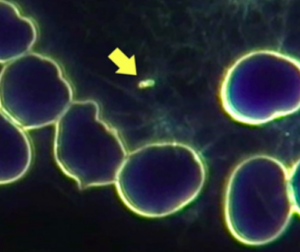
Rod-form bacteria present as rod-shaped bodies that move around actively in the plasma.
Appearance
Rod-form bacteria present as rod-shaped bodies that move around actively in the plasma.
Medical Perspective
As far as conventional medicine is concerned, bacteria will only be seen in the blood in septicaemia. However, various types of bacteria are clearly visible in live blood of patients who are not suffering from septicaemia and whose clinical situation correlates with the known imbalances associated with the presence of bacteria in blood samples. Very interesting research conducted in Canada and published in the Journal of Clinical Microbiology proved that bacteria are in fact present in the blood (J Clin Microbiol. 2002 December; 40(12): 4771-4775).
Pleomorphic Perspective
All bacterial forms of the endobiont develop from the symprotit. This process begins with the formation of the mychit, when a symprotit arranges nutritional reserves around it to create a cell. From here, the cystit can develop when the mychit’s nucleus enlarges; or the thecit develops when the nucleus divides. The mychit can also stretch and the nucleus then divides into two, the two nuclei then arrange themselves at the two opposite poles, forming a rod-form bacterium. The process of developing an ascit is started by the formation of a bacterial rod and can only occur in an environment that allows for it. The presence of ascits is often associated with dental foci.
Relevance
An optimally functioning immune system will prevent rod-forms from being present in a single drop of peripheral blood.
Implications
- Weak immune system – the resistance is deficient to the extent that rod-forms are observed in a drop of peripheral blood.
- These organisms prefer an acidic environment, and although the pH of the blood does not change much, their presence implies latent tissue acidosis.
- Infected foci
- Many rod-form bacteria indicate the presence of pathogenic bacteria and possible infection. A wide range of different bacterial forms in a sample also implies possible infection.
- Most clients with rod-form bacteria have some degree of mucus in the system, typically sinusitis, post nasal drip and possible upper respiratory tract infection.
Associated Symptoms
- Frequent colds and flu
- Prolonged simple infections
- Slow healing of wounds
- Post nasal drip
- Sinusitis
- Nasal catarrh
Working With
With live blood analysis one is able to see living microbes in the blood. The presence of bacteria is in the majority of cases not necessarily indicative of an infection. We are exposed to microorganisms on a daily basis in our environment. When they enter the blood stream, they are quickly destroyed by an optimally functioning immune system’s white blood cells. Microbial activity in the blood stream, while not indicative of an infection, alludes to an acidic biological terrain that is conducive to microbial activity and therefore unsuited for efficient cellular and immune function which requires a balanced alkaline biochemistry. Bear in mind that live blood analysis is not a sterile process and some bacteria may contaminate blood samples. It is possible that some bacteria visible in live blood samples entered the sample during the preparation of the specimen. This will be the most likely cause should you observe bacteria in nearly all your blood samples and if the client’s clinical situation does not correlate to the imbalances known to be associated with the presence of bacteria in live blood samples.
 Disclaimer