Pteroharpen are either butterfly or disc-shaped in appearance often with a head or tail. They may be seen individually (pteroharp) or colonized together (pteroharpen) as symplastic forms.
The edges of the “wings” are clear and reflective (less reflective than RBCs). They are most frequently seen around platelets. Pteroharpen should be differentiated from platelet fermentation, which may appear similar. In platelet fermentation, “bubbles” are seen around platelets. These are much smaller than pteroharpen and do not display the “wings” observed with pteroharpen.
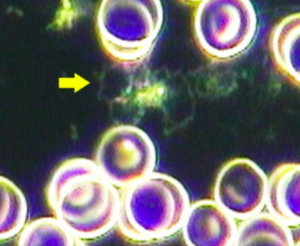
Appearance
Pteroharpen are either butterfly or disc-shaped in appearance often with a head or tail. They may be seen individually (pteroharp) or colonized together (pteroharpen) as symplastic forms.
The edges of the “wings” are clear and reflective (less reflective than RBCs). They are most frequently seen around platelets. Pteroharpen should be differentiated from platelet fermentation, which may appear similar. In platelet fermentation, “bubbles” are seen around platelets. These are much smaller than pteroharpen and do not display the “wings” observed with pteroharpen.
Pleomorphic Perspective
- Pteroharpen are pseudo-crystalline sclerotic protein formations.
- These pseudocrystals, consisting of dry excess protein, form as a result of excessive undigested protein in the blood (either from excessive intake of animal protein or deficient proteolytic enzymes).
- They may place extra strain on the heart and circulation and have been positively implicated in heart disease by Dr Majid Ali.
- Possible strong circulatory hindrance.
- High degree of pathogenic endobiontic development.
Relevance
- These forms are not observed in normal conditions and are indicative of a high degree of endobiosis.
Implications
- Pteroharpen are pseudo-crystalline sclerotic protein formations.
- These pseudocrystals, consisting of dry excess protein, form as a result of excessive undigested protein in the blood (either from excessive intake of animal protein or deficient proteolytic enzymes).
- They may place extra strain on the heart and circulation and have been positively implicated in heart disease by Dr Majid Ali.
- Possible strong circulatory hindrance.
- High degree of pathogenic endobiontic development.
 Disclaimer