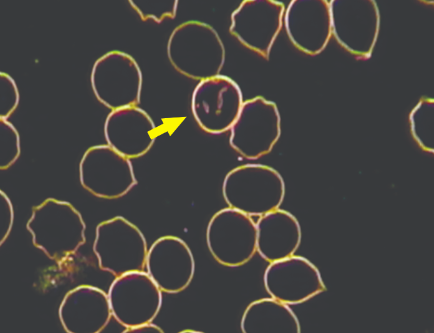
RBCs that are infected with microorganisms. These can include rod forms, I-forms, symprotits and ascits, which will be visible, moving within the RBCs. Parasitised RBCs may also appear to be moving on their own in the plasma after the rest of the RBCs have settled and stopped moving on the slide. RBCs that are parasitised may also display “flimmering” (an acronym for flickering and glimmering, where the central area of the RBC seems to flicker or glimmer). During this vegetative process high valence symprotits and ascits use a contained environment which provides nutritional reserves for their upward development.
RBCs may also be parasitised by the presence of chondrits on their membranes. These will not be visible during analysis unless the sample is stressed by pressing lightly on the cover slip with a pointed object like the tip of a pen. This breaks up the RBCs and releases the chondrits and other parasites from the cells. High valence chondrits are always observed in cancer, but their presence is not always indicative of cancer.
The degree of parasitism of the RBC may vary from “flimmering” within an otherwise normal appearing cell, to abnormally shaped RBCs with threads and lumps on the membranes.
Appearance
RBCs that are infected with microorganisms. These can include rod forms, I-forms, symprotits and ascits, which will be visible, moving within the RBCs. Parasitised RBCs may also appear to be moving on their own in the plasma after the rest of the RBCs have settled and stopped moving on the slide. RBCs that are parasitised may also display “flimmering” (an acronym for flickering and glimmering, where the central area of the RBC seems to flicker or glimmer). During this vegetative process high valence symprotits and ascits use a contained environment which provides nutritional reserves for their upward development.
RBCs may also be parasitised by the presence of chondrits on their membranes. These will not be visible during analysis unless the sample is stressed by pressing lightly on the cover slip with a pointed object like the tip of a pen. This breaks up the RBCs and releases the chondrits and other parasites from the cells. High valence chondrits are always observed in cancer, but their presence is not always indicative of cancer.
The degree of parasitism of the RBC may vary from “flimmering” within an otherwise normal appearing cell, to abnormally shaped RBCs with threads and lumps on the membranes.
Relevance
Parasitised RBCs is not a normal finding and is considered significant when observed during analysis. These anomalies may not be obvious at the beginning of the analysis and may only emerge after some time, or by pressurizing the sample.
Implications
- Parasites. It is important to note here that the parasites observed in live blood are endogenous, pleomorphic organisms that have developed into parasitic forms due to an unbalanced terrain. Exogenous parasites, such as liver flukes and intestinal worms are observed only in dry blood samples.
- Parasitised RBCs indicate a high degree of parasitism by the pathogenic forms of the endobiont due to an unbalanced terrain.
- These high valence parasitic forms are indestructible and can not be broken down by the WBCs.
- The WBCs can only allow themselves to become infected by these parasites to control their spread and circulation in the body.
- When this infestation reaches critical levels the burden on the WBCs is lessened by passing some of these parasites off to the RBCs.
- This means that where parasitised RBCs are observed, parasitised WBCs should also be seen. The system is only able to attempt to manage the situation – only correcting the imbalance of the terrain will resolve the condition.
Associated Symptoms
- Fatigue
- Skin and mucous membrane yeast and fungal infections.
- Susceptible to colds and flu.
 Disclaimer