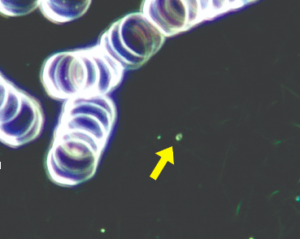
Mycoplasma are small, spheres or donut-shaped forms that can be seen moving around actively in the plasma or attached to RBCs. They are synonymous with sporoid symprotits and macrosymprotits in pleomorphism. They are also cell wall deficient, but differ from L-form bacteria in that they are completely unable to manufacture any cell wall components, whereas normal L-form bacteria are able to revert to a cell-walled form. In terms of their morphology in blood analysis, they are indistinguishable.
Appearance
Mycoplasma are small, spheres or donut-shaped forms that can be seen moving around actively in the plasma or attached to RBCs. They are synonymous with sporoid symprotits and macrosymprotits in pleomorphism. They are also cell wall deficient, but differ from L-form bacteria in that they are completely unable to manufacture any cell wall components, whereas normal L-form bacteria are able to revert to a cell-walled form. In terms of their morphology in blood analysis, they are indistinguishable.
Medical Perspective
Mycoplasmas are cell-wall deficient bacteria classified under the bacterial class Mollicutes. There are over 100 recognized species of the genus Mycoplasma. The bacterial class Mollicutes includes parasites and commensals of humans, other animals (including insects), and plants. The genus Mycoplasma is by definition restricted to vertebrate hosts. Mycoplasmas, and some other genera of mollicutes, require cholesterol to grow. Their optimum growth temperature falls within the range of their warm bodied host’s body temperature (e.g. 37° C in humans) and their cell membranes contain sterols, which are obtained from the host. Mycoplasma species were initially thought to be L-forms of bacteria, which also lack cell walls. Unlike mycoplasmal organisms, L-form bacteria do not have sterols in the cell membranes and they can revert to their walled parental forms. Emerging research has linked mycoplasma infections to various chronic diseases, including: amyotrophic lateral sclerosis, autism, chronic fatigue syndrome, fibromyalgia, rheumatoid arthritis, multiple sclerosis and asthma.
Pleomorphic Perspective
These forms are synonymous with sporoid symprotits and macrosymprotits. The number and the degree of variation in size indicate the degree of dysbiosis.
Relevance
An optimally functioning immune system will prevent mycoplasmas from being present in a drop of peripheral blood.
Implications
- Weak immune system
- Acidic terrain
- Excessive intake of sugar. Mycoplasmas feed on sugar and produces acids, such as sialic acid as metabolic end products.
Associated Symptoms
- Fatigue
- Frequent colds and flu.
- Prolonged simple infections
- Slow healing of wounds
- There are many different types of mycoplasmas, e.g. Mycoplasma arthritidis is associated with arthritic conditions, Mycoplasma pneumoniae is involved in respiratory conditions.
- Genitourinary tract diseases
- Mycoplasma is a single cell, cell wall deficient organism that tends to cause sore, achy muscles, pneumonia, arthritis and lupus-type symptoms.
 Disclaimer