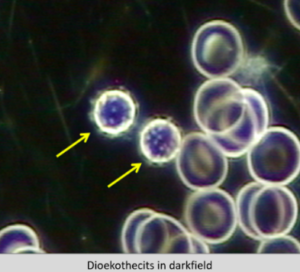
Dioekothecits are enormous thrombocytes, appearing as small spheres, varying in size from the size of a thrombocyte to that of a RBC. They have 7 or more nuclei in their wall, which also has many fine, hair-like fila (flagella). Since they are released by RBCs, their presence will be accompanied by RBCs that appear to have crescent cut outs (keratocytes/bite cells). Often confused with echinocytes, dioekothecits can be differentiated by noting the following:
- Dioekothecits are smaller than RBCs and spherical
- Their projections are much finer than those of echinocytes
- They are usually quite rarely observed
Appearance
Dioekothecits are enormous thrombocytes, appearing as small spheres, varying in size from the size of a thrombocyte to that of a RBC. They have 7 or more nuclei in their wall, which also has many fine, hair-like fila (flagella). Since they are released by RBCs, their presence will be accompanied by RBCs that appear to have crescent cut outs (keratocytes/bite cells). Often confused with echinocytes, dioekothecits can be differentiated by noting the following:
- Dioekothecits are smaller than RBCs and spherical
- Their projections are much finer than those of echinocytes
- They are usually quite rarely observed
Pleomorphic Perspective
Dioekothecits are ambivalent growth forms of the deposition phase, and are responsible for the release of sporoid spermits into the blood to boost the body’s defences. They usually have at least 7 nuclei in the cell wall with fine, hair-like flagella attached to the nuclei. These are spermits, which are composed of a head (symprotit) and a tail (fila). Spermits copulate with the nuclei of higher, pathogenic growth forms and break them down into apathogenic colloids.
Implications
- These forms appear as a result of the body’s response to pathogenic forms of the parasite.
- They are an expression of the system’s defence readiness.
- According to Enderlein, dioekothecits represent the beginning of an attack rather than advanced disease states.
- If present in high numbers an alarm situation is to be suspected, where the body is responding to the upward development of the parasite.
- This is regarded as a favourable sign as it is an expression of the body’s ability to regulate.
- However, the need for such aggressive regulation is a strong indication of ecological imbalance.
 Disclaimer