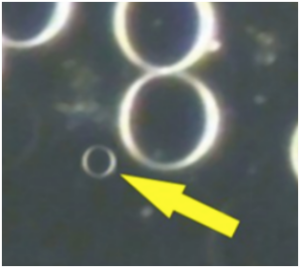
Colloid thecits are only observed in darkfield. They appear as small spheres, varying in size from very small to the size of a RBC. They contain colloids (not visible) within the fragile membrane and do not have any nuclei, hair-like growths or any other protuberances. They can be distinguished from higher, pathogenic forms such as mychits since they do not contain any nuclei. They can also be distinguished from RBCs and microcytes since colloid thecits have a very delicate, thin membrane that is much less reflective than those of RBCs.
Appearance
Colloid thecits are only observed in darkfield. They appear as small spheres, varying in size from very small to the size of a RBC. They contain colloids (not visible) within the fragile membrane and do not have any nuclei, hair-like growths or any other protuberances. They can be distinguished from higher, pathogenic forms such as mychits since they do not contain any nuclei. They can also be distinguished from RBCs and microcytes since colloid thecits have a very delicate, thin membrane that is much less reflective than those of RBCs.
Short Description
Mychits are the earliest bacterial-like structures to appear. They present as tiny, bright spheres and may occur individually or in small chains. As they develop, they may transform into thecits, which contain several internal colloids or nuclei and indicate early immune activation. Dioekothecits represent a further development stage, showing two or more nuclei and signalling increasing microbial activity within the terrain.
Pleomorphic Perspective
The colloid thecit is an ambivalent growth form of the deposition phase of the primary parasite, Mucor. Its function is to produce and release colloids as part of the system’s defence mechanism. These colloids will become spermits, which copulate with the nuclei of higher, pathogenic growth forms, thereby breaking them down into apathogenic colloids.
Implications
- The presence of colloid thecits is a favourable sign and an indication that the system is capable of launching a defence.
- They are not visualized in the blood of patients with AIDS and cancer, so in this case the absence of this form may be indicative of serious imbalance.
- The presence of many colloid thecits may imply that the system is preparing to launch a defence against some microbial challenge. Look for other signs of possible infections (‘left shift’, dioekothecits, etc).
 Disclaimer