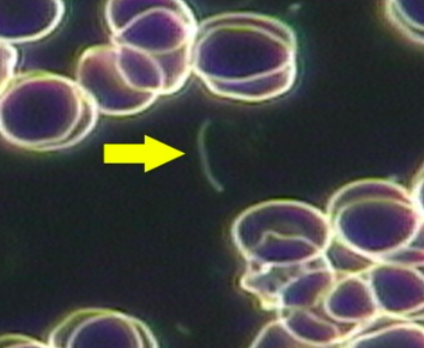
Chondrits are motile, thread-like growth forms that appear free in the plasma, or may be seen emerging from RBCs. They can occur as loose threads, intertwined threads and bunches of threads. (See L-form Bacteria).
Appearance
Chondrits are motile, thread-like growth forms that appear free in the plasma, or may be seen emerging from RBCs. They can occur as loose threads, intertwined threads and bunches of threads. (See L-form Bacteria).
Pleomorphic Perspective
The chondrit stage is the primitive stage of all microorganisms in the bacteria-fungal series. They have a high valence and dense arrangement of symprotits along the shaft. These filamentous forms develop within the RBCs, where they have access to nutritional reserves. Only the lower valence chondrits are apathogenic.
Relevance
Chondrits are not seen in the blood of healthy subjects, especially not free chondrits or chondrits that emerge spontaneously from the RBCs. Some low-valence chondrits will be observed in most people after pressurizing the sample. Look at the valence to determine pathogenicity: small, thin, relatively short chondrits, only seen after pressurizing the sample(*) is low valence (and low pathogenicity); larger, thicker and longer chondrits represent a more serious situation.
Implications
- Higher valences of these forms are present due to an acidic, dysregulated terrain and may be associated with chronic disease and or degeneration.
- May also be related to periodontal disease & dental foci.
- Some researchers have connected the presence of high-valence chondrits and ascites to Lyme Disease.
 Disclaimer