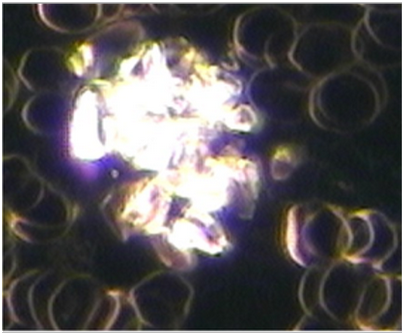
Crystal formation in the blood is a sclerotic process that is related to inflammation. The presence of crystalline forms is often associated with high blood pressure, plaque and atherosclerosis. There are often WBCs attached and attracted to crystal formations in the blood, attempting to engulf the crystals. This is a favourable sign and an indication of an active immune system.
short_description
Crystal formation in the blood is a sclerotic process that is related to inflammation. The presence of crystalline forms is often associated with high blood pressure, plaque and atherosclerosis. There are often WBCs attached and attracted to crystal formations in the blood, attempting to engulf the crystals. This is a favourable sign and an indication of an active immune system.
appearance
Uric acid crystals appear as light yellow to green (sometimes black) crystals in brightfield and bright, highly reflective crystals in darkfield that look like broken glass. They are the most reflective and brightest of all crystals in darkfield and often require one to turn the light intensity all the way down to see the crystal’s structure. Due to the crystalline, glass-like appearance of uric acid, these crystals are often transparent and may occur clusters of broken crystals.
relevance
Uric acid crystals are one of the most commonly observed crystals in live blood samples. More than 2 or 3 small crystals in more than 5 fields (under 400x magnification – using 40X objective and viewing the blood through 10X eyepieces) should be considered significant, or 2 or 3 large crystals (as pictured above) in one sample.
associated_symptoms
- Joint pain and stiffness are common symptoms, especially in chronic uric acid cases. This may range from mild tenderness and stiffness (typically worse after rest and on waking) to severe acute pain.
- Slow recovery after exercise, prolonged stiffness.
- In early stages it may be asymptomatic.
general_guidelines
- Reduce intake of dietary animal protein to 1g per kg body weight per day (e.g.: a 70kg adult should not exceed 70g animal protein daily).
- Do not consume animal protein and simple starch in the same meal.
- Eat meals while sitting down, do not rush while eating – remember to chew properly.
- Follow the diet relevant to the blood type.
- Identify and avoid hidden food sensitivities.
- Increase water intake. To determine necessary daily water intake (in litres): Weight (kg) / 8) x 0.25.
- Increase intake of fibre-rich carbohydrates (those tolerated by the blood type) and raw, polyunsaturated fats.
- Raw vegetable juices (especially celery), sprouts, greens and antioxidant-rich superfoods.
- Avoid saturated fat, refined carbohydrates and food deficient in natural enzymes.
- Smokers: stop smoking
- Avoid alcohol, caffeine, sugar, drugs and non-essential medication.
- Reduce intake of purine-rich foods.
medical_perspective
Uric acid accumulates as a result of:
Increased uric acid production:
- Increased intake of purine-rich foods: (e.g.: liver, kidney, heart, game meats, meat extracts, anchovies, scallops, mussels, mackerel and gravy). However, diet alone is generally not sufficient to cause high uric acid levels.
- Some haematological conditions (e.g.: lymphoma, leukaemia, haemolytic anaemia);
- Conditions of increased rates of cellular proliferation and cell death (e.g.: psoriasis, cytotoxic cancer therapy);
- Hereditary factors and
- Unknown factors.
Increased uric acid production:
- Increased intake of purine-rich foods: (e.g.: liver, kidney, heart, game meats, meat extracts, anchovies, scallops, mussels, mackerel and gravy). However, diet alone is generally not sufficient to cause high uric acid levels.
- Some haematological conditions (e.g.: lymphoma, leukaemia, haemolytic anaemia);
- Conditions of increased rates of cellular proliferation and cell death (e.g.: psoriasis, cytotoxic cancer therapy);
- Hereditary factors and
- Unknown factors.
Decreased uric acid excretion:
- Some medicines (e.g.: the primary antiuricosurics, diuretics, salicylates, pyrazinamide, ethambutol, nicotinic acid, cyclosporin, 2-ethylamino-1,3,4-thiadiazole and cytotoxic agents)
- Genetic factors;
- A ketogenic diet impairs the ability of the kidneys to excrete uric acid, due to competition for transport between uric acid and ketones;
- Elevated blood lead is associated with impaired kidney function and hyperuricemia;
Mixed causes (that both increase production and decrease excretion):
- High alcohol intake;
- High dietary fructose intake;
- Starvation causes the body to metabolize its own (purine-rich) tissues for energy.
pleomorphic_perspective
These are pseudocrystals that develop from protein colloids of the endobiont and other microbes. They form through the process of systatogeny and undergo dehydration, which creates their crystalline appearance. They are very resistant to extreme temperatures (Enderlein called them terrifying or permanent forms). Their colour indicates the system that is burdened: green = urogenital tract and kidneys; yellow and brown = upper abdomen, liver, gall bladder; cornflower blue = thyroid gland. Uric acid crystals are often seen in autoimmune disorders, ALS, MS, arthritis and gout. These are connective tissue disorders and fall under the Aspergillus niger cyclode.
implications
- These occur as a result of poor protein digestion and protein accumulation in the blood.
- Uric acid crystals can be seen in live blood samples of patients who also display protein linkage and/or kidney stress.
- Considered by some to be dried protein accumulations rather than uric acid itself, these crystals suggest a problem with protein digestion, over-acidity and/or elimination by the kidneys.
- Always ask about water intake, as insufficient water intake will affect the elimination of uric acid.
- High uric acid levels have been implicated in the risk of type 2 Diabetes, insulin resistance and metabolic syndrome.
interventions
Any combination of the following, depending on the rest of the case:
DIGESTIVE PROTOCOL:
- Digestal + NeoFlora + Bio-lonic Mineral Concentrate (Neogenesis Health Products).
ACIDITY PROTOCOL:
- Alkazen + Bio-lonic Mineral Concentrate (Neogenesis Health Products) + alkaline-forming diet.
KIDNEY PROTOCOL:
- Potassium supplement if kidney stress is suspected (correlate clinically).
- Nephrocil (Neogenesis Health Products): 30 drops tincture 3x daily. May be increased to 5ml tincture 3xdaily.
- Nephrolin (Neogenesis Health Products): 1 cap 1-3x daily.
- Reduce animal protein and acid-forming foods.
INFLAMMATION PROTOCOL:
- HumiCaps (Neogenesis Health Products): 2-4 capsules 2-4x daily.
- Curcumigen (Neogenesis Health Products): 1 capsule 1-2x daily.
- Glutathione 500 (Neogenesis Health Products): 1 capsule 1-2x daily.
- Trace minerals: Bio-lonic Mineral Concentrate (Neogenesis Health Products).
- Omega-3 supplement (1000-2000 EPA daily).
SUPPLEMENTS:
- Omega-3 supplement (1000-2000 EPA daily).
- Vitamin E: start with 400mg daily and gradually increase to 800mg daily.
- Digestive enzymes
- Vitamin B3, as non-flush Niacin (1000mg daily). Niacin helps to remove excess protein and saturated fat from the blood and stimulates hydrochloric acid production by the stomach.
further_investigations
- FBC + differential + ESR
- Urea, Electrolytes & Creatinine (UE+C)
- Liver Function Test (LFT)
- Glucose (fasting) + Insulin / GTT (Glucose Tolerance Test) +
- Insulin
- Serum Uric acid
- EU+C
 Disclaimer