Crystal formation in the blood is a sclerotic process that is related to inflammation. The presence of crystalline forms is often associated with high blood pressure, plaque and atherosclerosis. There are often WBCs attached and attracted to crystal formations in the blood, attempting to engulf the crystals. This is a favourable sign and an indication of an active immune system.
short_description
Crystal formation in the blood is a sclerotic process that is related to inflammation. The presence of crystalline forms is often associated with high blood pressure, plaque and atherosclerosis. There are often WBCs attached and attracted to crystal formations in the blood, attempting to engulf the crystals. This is a favourable sign and an indication of an active immune system.
appearance
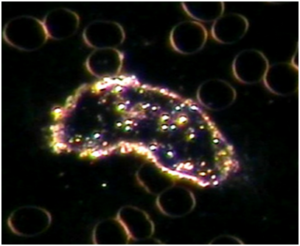
Looks like a rock in the blood. It can be round, oblong, irregular, or have jagged edges. (The larger and more jagged the edges, the more dangerous the finding.) The colour in brightfield is usually greenish and the structure is completely opaque. In darkfield these forms are usually appear evenly opaque, mostly black with a brightly reflective, white border. There are often bright reflective particles of various colours in the black area.
relevance
This is a potentially serious finding large protoplasts in high numbers with jagged edges are associated with chronic degenerative disease.
associated_symptoms
- Fatigue
- Headaches
- Skin disorders
- Immune weakness, recurring cold, flu or infections.
- Possible degenerative disease indications
general_guidelines
- Reduce intake of dietary animal protein to 1g per kg body weight per day (e.g.: a 70kg adult should not exceed 70g animal protein daily).
- Do not consume animal protein and simple starch in the same meal.
- Eat meals while sitting down, do not rush while eating – remember to chew properly.
- Follow the diet relevant to the blood type.
- Identify and avoid hidden food sensitivities.
- Increase water intake. To determine necessary daily water intake (in litres): Weight (kg) / 8) x 0.25.
- Increase intake of fibre-rich carbohydrates (those tolerated by the blood type) and raw, polyunsaturated fats.
- Raw vegetable juices (especially celery), sprouts, greens and antioxidant-rich superfoods.
- Avoid saturated fat, refined carbohydrates and food deficient in natural enzymes. Smokers: stop smoking
- Avoid alcohol, caffeine, sugar, drugs and non-essential medication.
- Smokers: stop smoking
pleomorphic_perspective
Protoplasts are termed symplasts in pleomorphism and specifically spheroplasts when they present as round, spherical formations. They form when excess colloids, nutritional reserves and other blood elements merge in a process of “Symplastism”. Symplastism is the merging of microbes for the purpose of sexual propagation. Excess colloids in the plasma will merge me to form symplasts like the examples above, but when the colloids are inside the blood cells, like the RBCs, they will pull the blood cells together, forming symplasts of the blood forms. An example of this is rouleau, which is an RBC symplast. Symplasts of excess colloids can dehydrate after forming, creating very dry, sclerotic forms. The harder symplasts are associated with more serious disease implications.
implications
- These crystals represent protein, fat and waste materials that have accumulated in the system.
- Usually observed when the diet & lifestyle is unhealthy.
- Implies a highly acidic terrain and the potential for the development of degenerative disease.
- Protoplasts can vary with regards to their appearance, depending on their composition. If they contain a high amount of fat they may have green ‘globules’ around them. They may also have small uric acid crystals on their surface.
- Strongly associated with toxicity and acidity.
- pH in the interstitium is too acidic and blood too alkaline (dysregulated terrain).
- Low tissue oxygenation
- As a result of the imbalanced terrain, the immune system is usually compromised.
- May be related to a degenerative disease process.
- Infections from decaying teeth with Streptococcus or Strep mutans.
- Patients undergoing amalgam removal often have protoplasts as a consequence.
- Bright red inclusions in protoplasts indicate the presence of actinomycin, an antibiotic produced by the body.
interventions
Any combination of the following, depending on the rest of the case:
DETOX PROTOCOL:
- Hepaton + Lymphlux + Nephrocil + HumiCaps (Neogenesis Health Products) + detox diet.
ACIDITY PROTOCOL:
- Alkazen + Bio-lonic Mineral Concentrate (Neogenesis Health Products) + alkaline-forming diet.
- DIGESTIVE PROTOCOL:
- Digestal + NeoFlora + Bio-lonic Mineral Concentrate (Neogenesis Health Products).
SUPPLEMENTS:
- Omega-3 supplement (1000-2000 EPA daily).
- Vitamin E: start with 400mg daily and gradually increase to 800mg daily.
- Buffered vitamin C (2500mg) and/or other antioxidants such as: Super Oxide Dismutase, proanthocyanidins, N-Acetyl Cysteine, selenium (200ug), beta carotene, zinc and glutathione.
- Vitamin B3, as non-flush Niacin (1000mg daily). Niacin helps to remove excess protein and saturated fat from the blood and stimulates hydrochloric acid production by the stomach.
- Bio-lonic Mineral Concentrate (Neogenesis Health Products)
working_with
Protoplast represent accumulated protein, fat and toxic material that the system has been unable to eliminate. Treatment is always geared towards improving the diet & lifestyle, detoxification and improving the pH.
Protoplasts are regarded by some to be a cell wall deficient bacterial parasite that produces toxins and indicates that the body is toxic and that the immune system is compromised. Pleomorphists believe it to be a conglomeration of excess colloids, nutritional reserves and other blood elements and indicative of dysbiosis. Either way, the presence of large numbers of protoplast structures in peripheral blood is an unfavourable sign, since they are associated with poor immune function, under-oxygenation and acidity.
These factors can lead to serious degenerative diseases and cancer. Livingston-Wheeler described these forms as a collection of Progenitor cryptocides (progenitor = existing across millennia/from the beginning; cryptocides = cellular killer).
These crystals are always indicative of an over-acidic terrain and a generally unbalanced terrain (under-oxygenation, toxicity, nutrient deficiency), usually with lifestyle factors. Protoplasts are often observed in high numbers in association with several cancers, AIDS, autoimmune connective tissue diseases, diabetes and impaired heart, liver and kidney function.
When these forms are observed during blood analysis, note the number, size and shape. Keep in mind the higher the number, the larger and the more irregular, jagged the shape the more serious the finding. Correlate all your information clinically and focus on a synergistic natural treatment program that includes fundamental lifestyle changes. It is important to monitor progress carefully in these clients due to the potentially serious implications of the finding.
further_investigations
- FBC + differential + ESR
- Urea, Electrolytes & Creatinine (UE+C)
- Liver Function Test (LFT)
- Lipogram (fasting) + Homocysteine
- Glucose (fasting) + Insulin / GTT (Glucose Tolerance Test) + Insulin
- C-reactive protein
- D-Dimer (alternative to FDP – Fibrinogen Degradation Products)
- TNF (Tumour Necrosis Factor) + Tumour markers
- RF (Rheumatoid Factor) + ANF (Antinuclear Factor)
 Disclaimer