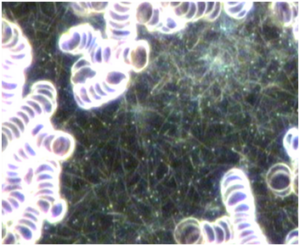
Straight, stick-like formations that occur in varying degrees of length, thickness and complexity in the plasma. Also referred to as “spicules”. They may form throughout the plasma as pictured above (Diffuse fibrin), or may occur in association with platelet aggregations, growing out from the aggregated platelets. Short fibrin clusters may occur in groups, as pictured above (Precipitated fibrin), referred to as birds’ nest patterns. These may also have an open, round area in the centre, presumably a RBC remnant.
short_description
Straight, stick-like formations that occur in varying degrees of length, thickness and complexity in the plasma. Also referred to as “spicules”. They may form throughout the plasma as pictured above (Diffuse fibrin), or may occur in association with platelet aggregations, growing out from the aggregated platelets. Short fibrin clusters may occur in groups, as pictured above (Precipitated fibrin), referred to as birds’ nest patterns. These may also have an open, round area in the centre, presumably a RBC remnant.
appearance
Fibrin is rarely observed in brightfield, unless very severe. Fibrin will become more evident the longer the sample sits on the slide. It is a much more relevant finding when observed within the first 15 minutes of the analysis. Note how quickly fibrin forms, and how thick and dense the network is. This will indicate the level of pathogenicity. Fibrin is not observed in healthy samples and will only develop after 30-40 minutes. Fibrin may appear as precipitated clusters (“birds’ nests pattern”) or as diffuse fibrin. Finding precipitated clusters is less serious than diffuse fibrin.
relevance
associated_symptoms
- Unrefreshing sleep or restless sleep between 1am and 3am.
- Irritability
- Constipation, bloating, gas, flatulence
- Indigestion, heartburn
- Fatigue
- Headaches, backaches, arthritic pain
- Nausea and other reactions from fatty foods, alcohol and caffeine.
general_guidelines
- Follow the diet relevant to the blood type.
- Identify and avoid hidden food sensitivities.
- Increase water intake. To determine necessary daily water intake (in litres): Weight (kg) / 8) x 0.25.
- Increase intake of fibre-rich carbohydrates (those tolerated by the blood type) and raw, polyunsaturated fats.
- Raw vegetable juices (especially celery), sprouts, greens and antioxidant-rich superfoods.
- Avoid saturated fat, refined carbohydrates and food deficient in natural enzymes. Smokers: stop smoking
- Avoid alcohol, caffeine, sugar, drugs and non-essential medication.
- Smokers: stop smoking
medical_perspective
Fibrin (also called Factor la) is a fibrous, non-globular protein involved in blood coagulation. The protease thrombin facilitates the conversion of (inactive) fibrinogen to (active) fibrin, which is then polymerised to form a “mesh” that forms a haemostatic plug or clot (in conjunction with platelets) over a wound site.
Excessive generation of fibrin due to activation of the coagulation cascade leads to thrombosis, which usually results in the blockage of a blood vessel by the blood clot. Ineffective generation or premature lysis of fibrin predisposes to haemorrhage.
pleomorphic_perspective
Spicules or fibrin are excess pathogenic colloids that have accumulated in the body and have arranged themselves linearly. This is the chondroid-dendrite form of the endobiont. The earlier, apathogenic filit-phase of the Mucor cycle is involved in normal clotting. The thicker, higher valence forms are found in the pathogenic part of the cycle, often with coccoidal forms like chondrits in the plasma or within RBCs. The thicker the filit, the higher the valence of the accumulated colloids and the more pathogenic the condition is.
implications
There are two separate mechanisms by which fibrin is produced in the plasma, both of which involve the liver. Firstly, fibrin is formed from fibrinogen, one of the acute phase proteins, which are produced by the liver in response to inflammation. Secondly, heparin, an anticoagulant factor, is degraded in liver diseases. Even a moderate deficiency in serum heparin levels may accelerate fibrin production.
Precipitated fibrin clusters (“birds’ nests patterns”) are related to liver stress, increased toxic load on the liver, bowel toxicity and possible increased gut permeability (Leaky Gut Syndrome).
Diffuse fibrin is associated with possible liver cell damage and possible raised liver enzymes (ALT, AST). This is not significant if observed in the zone of aggregation, or after 20 minutes of analysing the sample.
Fibrin is one of the elements of blood coagulation, so an increased level of fibrin in the plasma will lead to increased blood viscosity and the potential of cardiovascular disease risk.
Fibrin could also be a healing indicator in cases where a general detoxification and liver cleanse is in progress.
Toxins such as: alcohol, caffeine, tobacco, saturated/animal fat, sugar (and refined starch), heavy metals, drugs and medication (like paracetamol, antibiotics, cholesterol/statins, Roaccutane, etc) and stress. Look for these in the client’s diet as these may be the cause of fibrin and will certainly aggravate it.
Acidic terrain
Maldigestion and/or bacterial overgrowth can be suspected as cause of bowel toxicity along with old, decaying, impacted faecal matter.
interventions
Any combination of the following, depending on the rest of the case:
DETOX PROTOCOL:
- Hepaton + Lymphlux + Nephrocil + HumiCaps (Neogenesis Health Products) + detox diet.
LIVER PROTOCOL:
- Avoid alcohol, caffeine, tobacco, saturated/animal fat, sugar, drugs and non-essential medication.
- Hepaton (Neogenesis Health Products): 30 drops tincture 3x daily. May be increased to 5ml tincture 3xdaily.
BOWEL PROTOCOL:
- NeoFlora + HumiCaps (Neogenesis Health Products) + alkaline-forming diet.
- Psyllium husk fibers
INFLAMMATION PROTOCOL:
- HumiCaps (Neogenesis Health Products): 2-4 capsules 2-4x daily.
- Curcumigen (Neogenesis Health Products): 1 capsule 1-2x daily.
- Glutathione 500 (Neogenesis Health Products): 1 capsule 1-2x daily.
- Trace minerals: Bio-lonic Mineral Concentrate (Neogenesis Health Products).
- Omega-3 supplement (1000-2000 EPA daily).
DIGESTIVE PROTOCOL:
- Digestal + NeoFlora + Bio-Ionic Mineral Concentrate (Neogenesis Health Products).
SUPPLEMENTS:
- Omega-3 supplement (1000-2000 EPA daily).
- Vitamin E: start with 400mg daily and gradually increase to 800mg daily.
- Buffered vitamin C (2500mg) and/or other antioxidants such as: Super Oxide Dismutase, proanthocyanidins, N-Acetyl
- Cysteine, selenium (200ug), beta carotene, zinc and glutathione.
- Vitamin B3, as non-flush Niacin (1000mg daily). Niacin helps to remove excess protein and saturated fat from the blood and stimulates hydrochloric acid production by the stomach.
- Bio-lonic Mineral Concentrate (Neogenesis Health Products).
working_with
The approach to treatment of a case with significant spicules is firstly to detoxify the liver and colon. Many spicules accompanied by protein linkage, rouleau and RBC aggregation indicate accumulated protein in the blood. Remember that the severity of the condition can be assessed by the thickness, density and complexity of the spicules and how quickly they form. When alcohol consumption, medication and liver and bowel toxicity have been ruled out and spicules show no response after natural interventions further investigations are necessary.
further_investigations
- Urinary indican test
- Liver Function Test (LFT)
- Colonoscopy
- TNF + tumour markers
- Clotting profile
- D-Dimer
- C-reactive protein
- ANF + RF
 Disclaimer