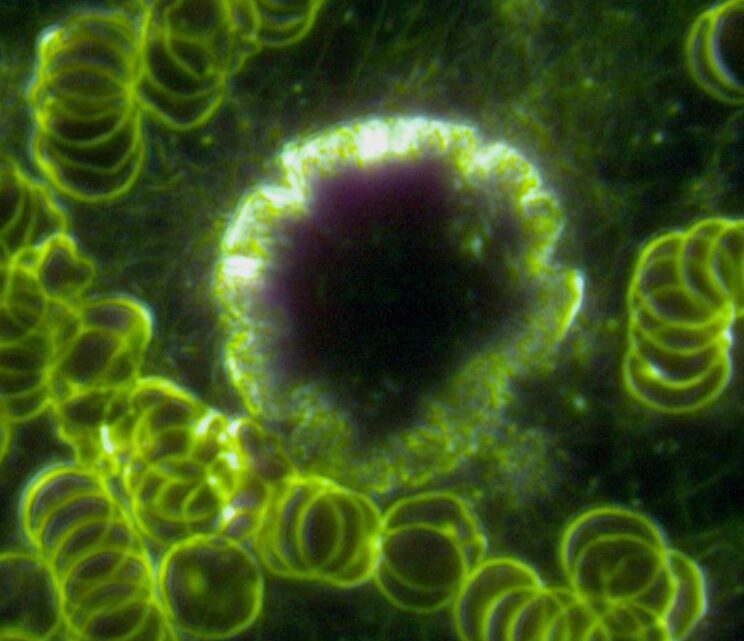
This image shows what is known as a symplast — a dense protein–fibrin mass often associated with oxidative stress and toxic load in the body. Unlike red blood cells, which are smooth and uniform, the symplast appears as a dark central body with a bright, irregular edge. Red cells can often be seen clustering around it, as in this image, where their normal circulation is disrupted by the presence of the larger mass.
Symplasts are thought to represent accumulations of cellular debris and sticky proteins, forming when the blood becomes burdened with toxins, inflammation, or oxidative damage. Under darkfield microscopy, they stand out dramatically, looking almost like a glowing crater or “shadowed sun” surrounded by the smaller, uniform rings of red blood cells. Their presence is a visual reminder of how lifestyle, environment, and stress can directly influence the blood’s terrain.
 Disclaimer