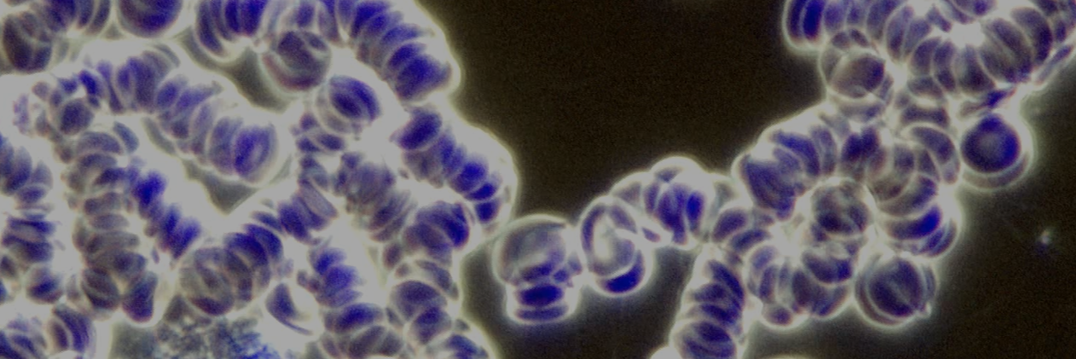
Appearance
Large numbers of RBCs randomly piled on top of one another. Also referred to as clumping or ‘blood sludge’ as the cells are severely agglutinated. Erythrocyte aggregation can be distinguished from rouleau in that rouleaux are arranged linearly, whereas the RBCs in aggregation are stuck together in a 3-dimensional pattern.
Relevance
RBC aggregation at the periphery of the sample is ignored. It becomes significant when it occurs in the working area of the sample. When a honeycomb pattern is observed in the working area, it is regarded as a serious indication of aggregation.
Implications
- More severe finding than protein linkage or rouleau, and may relate to degenerative conditions.
- Severe aggregation restricts blood flow, causing circulatory and organ stress.
- Stickiness of RBCs results from increased serum proteins (fibrinogen and immunoglobulins).
- The process begins with protein linkage (mild), through rouleau (moderate), to aggregation (severe).
- Loss of zeta potential (RBC negative charge) allows proteins to attach, rendering cells sticky.
- Excess acidity reverses cell polarity, causing attraction instead of repulsion.
- Trace mineral and electrolyte deficiencies disrupt pH and enzyme function, impairing nutrient absorption.
- Observed in inflammation, infection, chronic liver disease, alcoholism, and dehydration.
- Indicates chronic toxicity from long-term stress, poor elimination, caffeine, meat, and drugs.
- Associated with hypercholesterolemia and dehydration.
Associated Symptoms
Patients with erythrocyte aggregation usually complain of fatigue, shortness of breath, and poor circulation (cold hands/feet, cramps, tingling, numbness). This occurs because RBCs’ ability to pass through capillaries in single file is severely compromised, reducing gas exchange. Blood sludge can lead to clotting and occlusive vascular disease.
Pleomorphic Perspective
The primary parasite’s urge to merge pulls RBCs, WBCs, and platelets together for propagation. This creates a culturing ground for parasites to advance through life phases. Under darkfield, the process becomes visible as endobionts evolve upwards when the terrain is acidic. Such a terrain, created by poor diet and lifestyle, promotes further upward evolution of endobionts. The acidic environment maintains pH imbalance as the endobiont secretes acids — lactic acid (by Mucor) and citric acid (by Aspergillus).
Medical Perspective
Red cell sludging (agglutinated erythrocytes) may occur due to altered cell membranes, allowing adherence to adjacent cells. Lipoproteins, fats (including arachidonic acid), and acute phase proteins are implicated in blood sludge formation. Myocardial infarction, angina, neoplastic and atherosclerotic processes, and venous thrombosis correlate with severe aggregation. High blood viscosity from aggregation can affect patient survival, with reductions in sludging improving prognosis.
Interventions
Detox Protocol:
- Hepaton + Lymphlux + Nephrocil + HumiCaps (Neogenesis Health Products) + detox diet.
Acidity Protocol:
- Alkazen + Bio-Ionic Mineral Concentrate (Neogenesis Health Products) + alkaline-forming diet.
Digestive Protocol:
- Digestal + NeoFlora + Bio-Ionic Mineral Concentrate (Neogenesis Health Products).
Supplements:
- Omega-3: 1000–2000 mg EPA daily
- Vitamin E: start with 400 mg daily, increase to 800 mg.
- Buffered Vitamin C (2500 mg) and/or antioxidants: SOD, proanthocyanidins, NAC, selenium (200 µg), beta-carotene, zinc, and glutathione.
- Vitamin B3 (non-flush Niacin, 1000 mg daily): helps remove excess protein and fat, stimulates gastric acid.
General Guidelines:
- Limit dietary animal protein to 1 g/kg body weight per day.
- Avoid combining protein and starch in the same meal.
- Sit and chew food properly; eat calmly.
- Follow diet per blood type.
- Avoid hidden food sensitivities.
- Increase water: Weight (kg) ÷ 8 × 0.25 = daily litres.
- Emphasize fibre, sprouts, greens, and raw superfoods.
- Avoid refined carbohydrates and processed fats.
- Stop smoking, avoid alcohol, caffeine, sugar, and non-essential medication.
Working with RBC Aggregation
- This condition may indicate serious pathology and should be approached with caution. If present, priority should be detoxification and pH correction. Aggregation is often seen with renal urea, fibrin, poikilocytes, and other crystals. If unresponsive to nutritional intervention, further clinical tests are required.
Further Investigations
• FBC + Differential + ESR • C-Reactive Protein • D-Dimer (FDP alternative) • Clotting profile • Cardiac Enzymes: AST, LDH, CK, CK-MB, Troponin-T • TNF (Tumour Necrosis Factor) + Tumour markers • Thyroid function test • Lipogram • Homocysteine • Circulatory studies: plethysmographic and Doppler evaluation, ECG, phonocardiography
 Disclaimer