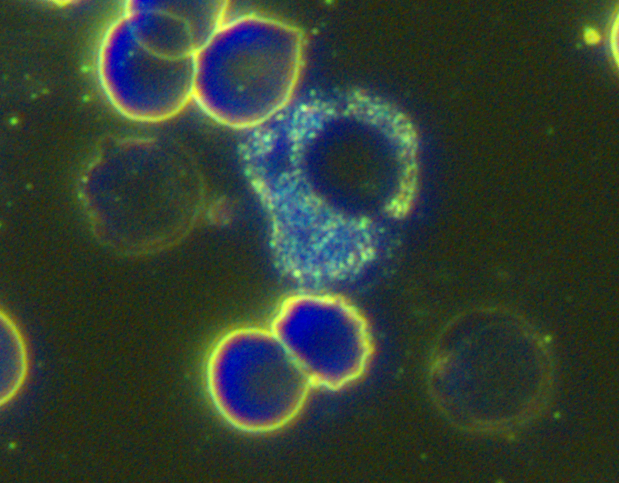
Eosinophils are the striking orange-red granulated cells (10–15 µm) with a characteristic bilobed “spectacle” nucleus. Under darkfield they look like tiny glowing pumpkins – impossible to miss when present.
How they come about
Produced in the bone marrow under the direction of IL-5 (a cytokine released during allergic and parasitic challenges). When the body senses parasites or allergens, eosinophil production ramps up dramatically within days.
What they do
Highly specialised anti-parasite warfare and allergy modulation:
- Release powerful cytotoxic proteins (major basic protein, eosinophil cationic protein) that punch holes in large parasites too big for phagocytosis
- Secrete inflammatory mediators that amplify allergic responses
- Help regulate mast-cell and basophil activity
They are the body’s “heavy artillery” for multicellular invaders and over-the-top IgE reactions.
Where they can go
Strong preference for mucosal surfaces:
- Lungs and respiratory tract
- Gastrointestinal tract
- Skin and connective tissues
- Urogenital tract
This is why eosinophilia often appears in asthma, eczema, food sensitivities, and parasitic gut infections.
Lifespan
- In blood: 8–12 hours
- In tissues: up to 12–14 days (much longer than neutrophils)
In practice
Seeing ≥1 eosinophil in most fields at 200× almost always means one (or more) of the following is active:
- Parasitic infection (worms, protozoa)
- Allergic or atopic state (hay fever, asthma, eczema, food intolerance)
- Fungal overgrowth (especially Candida or Aspergillus)
- Heavy-metal burden (they get recruited to detox reactions)
A single eosinophil waving at you under the scope is the blood politely saying: “Something itchy or wormy is going on – please investigate the gut, lungs, or skin!”
Appearance
Bright orange-red granules, bilobed nucleus
Relevance
Suspect when ≥1 in most fields
Implications
Parasites, allergies, fungal overgrowth, heavy metals
Interventions
Core Immune Protocol + Black cumin seed oil + Quercetin 1–3 g/day + Vitamin C to tolerance
 Disclaimer